PQ-NEXT Core: Bringing PQ-NEXT into higher education- the case of HSRM
PQ-NEXT Core: Bringing PQ-NEXT into higher education- the case of HSRM
What drives PQ-NEXT from within? This time, we sat down with our academic partners to discuss their role and contributions to the PQ-NEXT project.
Let’s meet and greet the RheinMain University of Applied Sciences and Arts. We will discover the university, the background, the team and the journey that led them in PQ-NEXT.
The RheinMain University of Applied Sciences and Arts is a university in the city of Wiesbaden, the capital of the German state of Hesse. We have a strong research focus on smart cities, metropolitan networks, and the application of quantum technology in smart city infrastructures. For example, one of the pioneering QKD networks in Germany is currently being operated over a distance of around 7 km between RheinMain University of Applied Sciences and the Hessische Zentrale für Datenverarbeitung, the Hessian full-stack IT provider for public institutions.
Due to the interplay between public service infrastructures, smart cities, post-quantum cryptography, and specialised network expertise, we are the ideal partner to address the synergies between applied research and practical teaching within the PQ-NEXT project. Our long-term collaboration with various project partners has led to several ideas, which we hope to further develop and mature during the project.
The RheinMain University of Applied Sciences and Arts and its role within PQ-NEXT
As mentioned above, RheinMain University of Applied Sciences is a public university of applied sciences with a strong research focus and independent doctoral rights in fields such as computer science, mobility and logistics, and social sciences, among others. Within PQ-NEXT, we plan to work on migration strategies from traditional cryptography to post-quantum infrastructures. By involving two PhD students, we aim to make substantial contributions to the infrastructure migration kit in Work Package 2, thereby creating a practical tool for public institutions to support the migration of their networks and data centres toward resilient post-quantum cryptography.
How does your work in PQ-NEXT influence your teaching activities and curriculum development?
The university already offers many relevant courses, such as telecommunications networks, post-quantum cryptography, cybersecurity, digital government, and information and communication technology for smart cities. The participation in PQ-NEXT will help us to enhance excellence in teaching by creating a bridge between cutting-edge research and practical teaching for the engineers and computer scientists of the future. We plan to supervise bachelor’s, master’s, and PhD theses throughout the project, as well as offer practical student projects to complement our existing curriculum.
What skills should today's students develop to be ready for the post-quantum era?
Depending on their specific role, students would need skills in cryptography, public key infrastructures, network protocols and telecommunication infrastructures, data centres and cloud computing, as well as cybersecurity, risk management, and structured vulnerability analysis and penetration testing.
How can students participate in quantum-safe cybersecurity research at your institution, and, in particular, in the PQ-NEXT project?
Students will be involved in projects, as well as in bachelor’s, master’s, and PhD theses, with the additional opportunity to work on cutting-edge research as junior researchers in the participating research groups.
How does collaboration with industry partners within PQ-NEXT enrich academic research?
Collaboration with industry partners will help us align the applied aspects of our research more closely with practical needs and increase the relevance of our activities in the fields of smart cities and metropolitan network architecture. It will also support the transfer between fundamental research, applied teaching, and the use of future technologies within industries and companies in the RheinMain region of Germany.
What excites you most about the future impact of PQ-NEXT?
We are convinced that the PQ-NEXT research will have a major impact on the future of networks and data centres across Europe. The shift to new cryptographic schemes is inevitable, and the transition needs to be carefully prepared and systematically executed. This is exactly the area in which our PQ-NEXT research will support the future transition of our infrastructure.


PQ-NEXT Core: Bringing PQ-NEXT into higher education - the case of AGH
PQ-NEXT Core: Bringing PQ-NEXT into higher education - the case of AGH
What drives PQ-NEXT from within? This time, we sat down with our academic partners to discuss their role and contributions in the PQ-NEXT project.
Let’s meet and greet the AGH University of Krakow (AGH). We will discover the university, the background, the team and the journey that led them to PQ-NEXT.
AGH University of Krakow (AGH) is a public university in Poland, founded in 1913. The university is one of 10 Polish higher education institutions that have been granted the title of a research university. AGH is recognized as the best of Polish technical universities in many international rankings (including CWUR, CWTS Leiden Ranking or Shanghai Ranking). The university comprises 18 faculties, research centers, and other didactic centers and departments. The supercomputers from the TOP500 list of the fastest supercomputers in the world operate in the Academic Computer Centre Cyfronet AGH. AGH offers three levels of education, including doctoral schools. The university educates more than 20,000 students and employs approx. 2,000 academic staff.
The PQ-NEXT team at AGH University works on Institute of Telecommunications and Cybersecurity. The Institute has broad experience in teaching and research in the field of telecommunications, computer science, and cybersecurity. The development strategy includes quantum technology and post-quantum solutions (e.g., quantum and post-quantum cryptography, security architectures and protocols, intrusion detection and mitigation, etc.). The institute has participated in many 4th, 5th, 6th, 7th, H2020 UE Framework Programs, EUREKA CELTIC, EDA, and COSTs projects.
The AGH University of Krakow (AGH) and its role within PQ-NEXT
AGH team—consisting of ten researchers, including two professors—is supporting PQ-NEXT project in research on quantum and post-quantum cryptography solutions, especially security analysis and performance evaluation. Also, integration of post-quantum cryptography algorithms with contemporary systems and networks is important research direction. Our contribution to the PQ-NEXT project is mainly focusing on post-quantum migration and quantum cryptanalysis.
How does your work in PQ-NEXT influence your teaching activities and curriculum development?
The influence is significant indeed. Universities are not only at the forefront of research in quantum computing and post-quantum cryptography, but they are also responsible for preparing the next generation of professionals. Therefore, we teach the future engineers, researchers, and security experts how and why post-quantum solutions work. For example, as part of the second-cycle Cybersecurity programme, AGH has introduced a compulsory master-level course dedicated specifically to post-quantum cryptography, positioned as a core subject directly linked to ongoing research projects, international collaboration and standardisation activities. This ensures that every graduate of the programme encounters quantum-related security challenges not as a niche curiosity, but as an integral element of their professional formation.
What skills should today's students develop to be ready for the post-quantum era?
Firstly, students should introduce quantum-related concepts early in the educational journey. Introducing fundamental concepts of quantum computing and post-quantum cryptography at the undergraduate level allows students to gradually build awareness of upcoming technological shifts and better understand the context of more advanced topics. However, the education should be consistently continued and deepened at the master’s level, where a more advanced knowledge and specialized skills are developing, covering both theoretical foundations and practical applications. Practical experience—such as standard analysis, implementation of post-quantum algorithms, integration of them into network protocols and systems, and benchmarking their performance—allows students to move beyond theory and understand real-world constraints, even if these are group projects within existing courses. Such approaches not only strengthen technical competence but also better reflect the challenges graduates will face in practice. However, universities should also foster interdisciplinary collaboration across computer science (including quantum algorithmics), mathematics, physics, and telecommunications to provide students with a holistic understanding of quantum technologies.
How can students participate in quantum-safe cybersecurity research at your institution, and, in particular, in the PQ-NEXT project?
Interested AGH students are actively involved in collaborative research activities within PQ-NEXT project, where they contribute to the implementation and testing of post-quantum solutions. This provides valuable hands-on experience with cutting-edge technologies, and the most successful outcomes often lead to joint scientific publications. In addition, the explored research topics frequently inspire the selection of bachelor's and master's thesis topics, enabling students to further develop their expertise in post-quantum cryptography and related fields. Then, the most motivated students have a smooth path to their PhD studies devoted to the post-quantum cryptography topics.
How does collaboration with industry partners within PQ-NEXT enrich academic research?
Close collaboration between academia and industry is essential for bridging the gap between research and real-world applications. Such partnerships facilitate the transfer of scientific advances into practical solutions, enable researchers and students to address genuine industrial challenges, and ensure that research remains aligned with current technological and societal needs. They also foster innovation, accelerate the adoption of emerging technologies, and better prepare graduates for careers in both academia and industry.
What excites you most about the future impact of PQ-NEXT?
The most exciting aspect is the opportunity to actively participate in one of the hottest research topics today—the development of quantum technologies. It is a unique chance to witness firsthand the ongoing migration toward post-quantum cryptography and to contribute to this historic technological transition while collaborating within an outstanding European research consortium.

Collaboration To Foster European Involvement in Future Quantum Standards

Collaboration To Foster European Involvement in Future Quantum Standards
PISA – Italy, July 1st, 2026 – StandICT.eu & PQ-NEXT announce their collaboration with the signature of a Memorandum of Understanding (MoU).
Quantum technologies are moving towards technological maturity and wider adoption. From a market perspective, one measure to accelerate development and uptake is the promotion of coordinated, dedicated standardisation and certification efforts. Currently, the industry is relatively fragmented, with few to no standards in place. And yet, standardisation is a crucial foundation for the field to mature and harmonise the European quantum supply chains through interoperability across systems, technologies, ecosystems, and companies.
Standardisation facilitates the development of new technologies and the creation of efficient, effective supply chains. With this in mind, two European research and innovation initiatives have joined forces to foster the European contribution to developing these required new quantum standards.
On one side, StandICT.eu, a EU-funded initiative that has been running since 2018 with the central objective of fostering the participation of European experts in international ICT standardisation.
To reach this goal, it has four main axes:
- It runs a Fellowship programme funding 300+ European standardisation experts through 6 Open Calls, providing over €4 million in direct funding.
- It manages the European Observatory for ICT Standardisation (EUOS), an interactive online ecosystem that includes an up-to-date standards repository and working groups sharing insights on ongoing standardisation efforts across different initiatives.
- Through its Academy, it trains future experts in ICT standardisation.
- It proposes a mentoring programme that connects ICT standardisation professionals to exchange knowledge and best practices, thereby improving engagement in global digital standardisation.
StandICT.eu focuses on horizontal and vertical ICT fields as defined in the Rolling Plan for ICT Standardisation; one of the focuses is quantum computing and technologies. Through its fellowship programme, it has supported several European experts financially in developing standards and chairing working groups across different Standards Development Organisations (SDOs), namely CEN/CENELEC, ETSI, ISO, and ISO/IEC. This topic remains a priority within the Fellowship Programme and its future open calls.
On the other side, PQ-NEXT, a European research and innovation project co-funded by the European Union, aims to develop a migration framework to analyse and model scenarios for a smooth transition to post-quantum cryptographic (PQC) standards, with tailored migration plans. PQ-NEXT focuses especially on Quantum cryptography-related standards with the aim of engaging the project’s results in the development of new standards in this field.
This announced collaboration can further consolidate these commitments of both projects.
“Europe’s position in quantum technologies will depend on its capacity to turn research excellence into a consistent and coordinated influence in global standardisation. The collaboration with PQ-NEXT is a great opportunity to strengthen that pathway, helping experts engage where future requirements for trust, interoperability and competitiveness are being defined.”
Maria Giuffrida, StandICT.eu Coordinator (from Trust-IT)
“Post-quantum cryptography is not a future concern, it is an immediate priority. The work we are doing within PQ-NEXT to develop migration frameworks and engage with standardisation bodies will be more effective when undertaken in joint action with initiatives like StandICT.eu. Together, we can ensure that Europe shapes the global standards that will underpin the security of our digital infrastructure for decades to come.”
Akis Kourtis, PQ-NEXT Project Coordinator (from Demokritos)
Read more about quantum standardisation
Published by the European Commission:
Published by the CEN/CENELEC Focus Group on Quantum Technology (FGQT):
- Towards European Standards for Quantum Technologies
- European Standardisation Roadmap on Quantum Technologies
PQ-NEXT General Assembly Meeting in Berlin, Germany
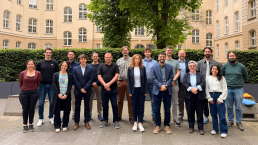
PQ-NEXT General Assembly Meeting in Berlin, Germany
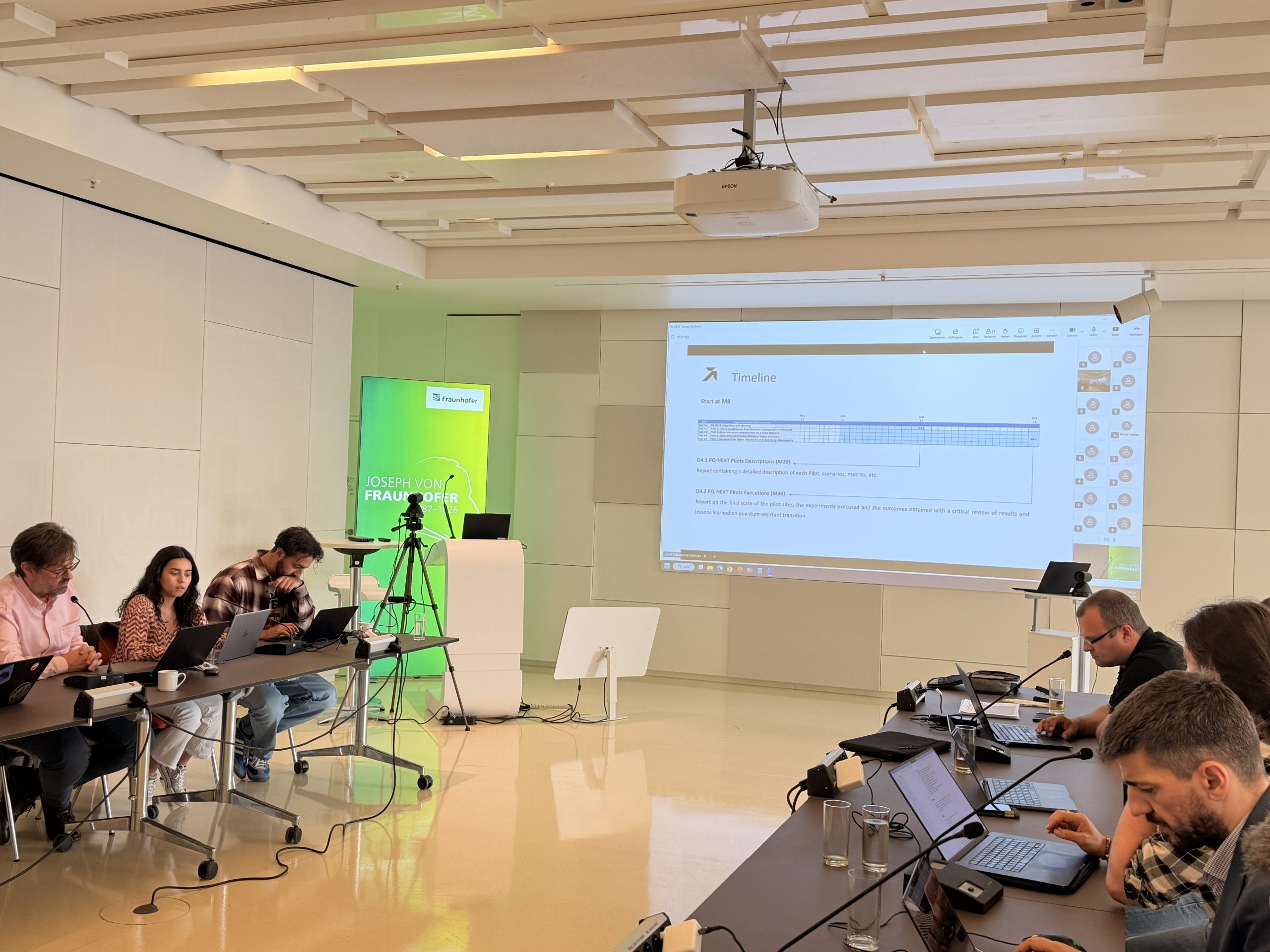
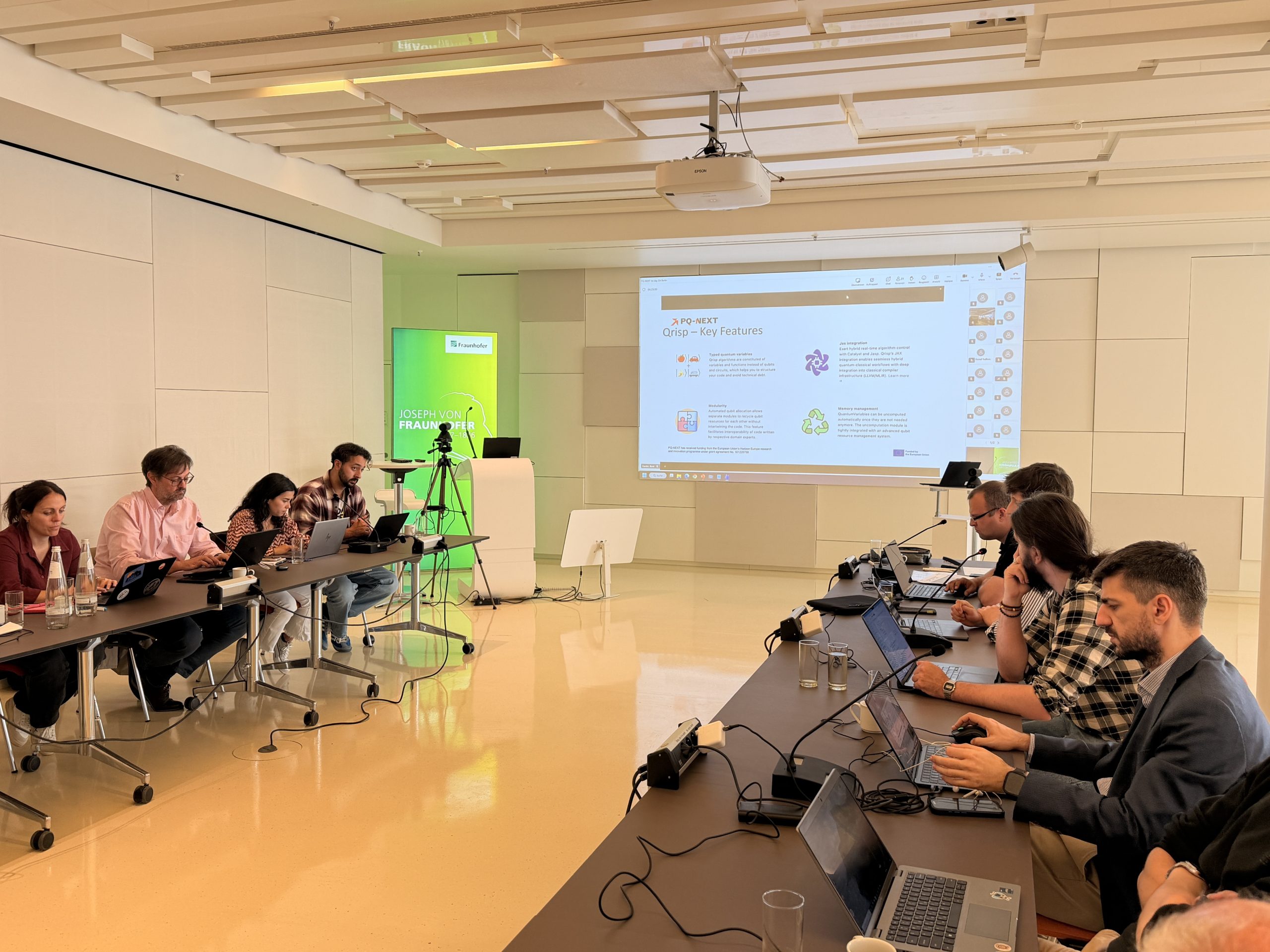
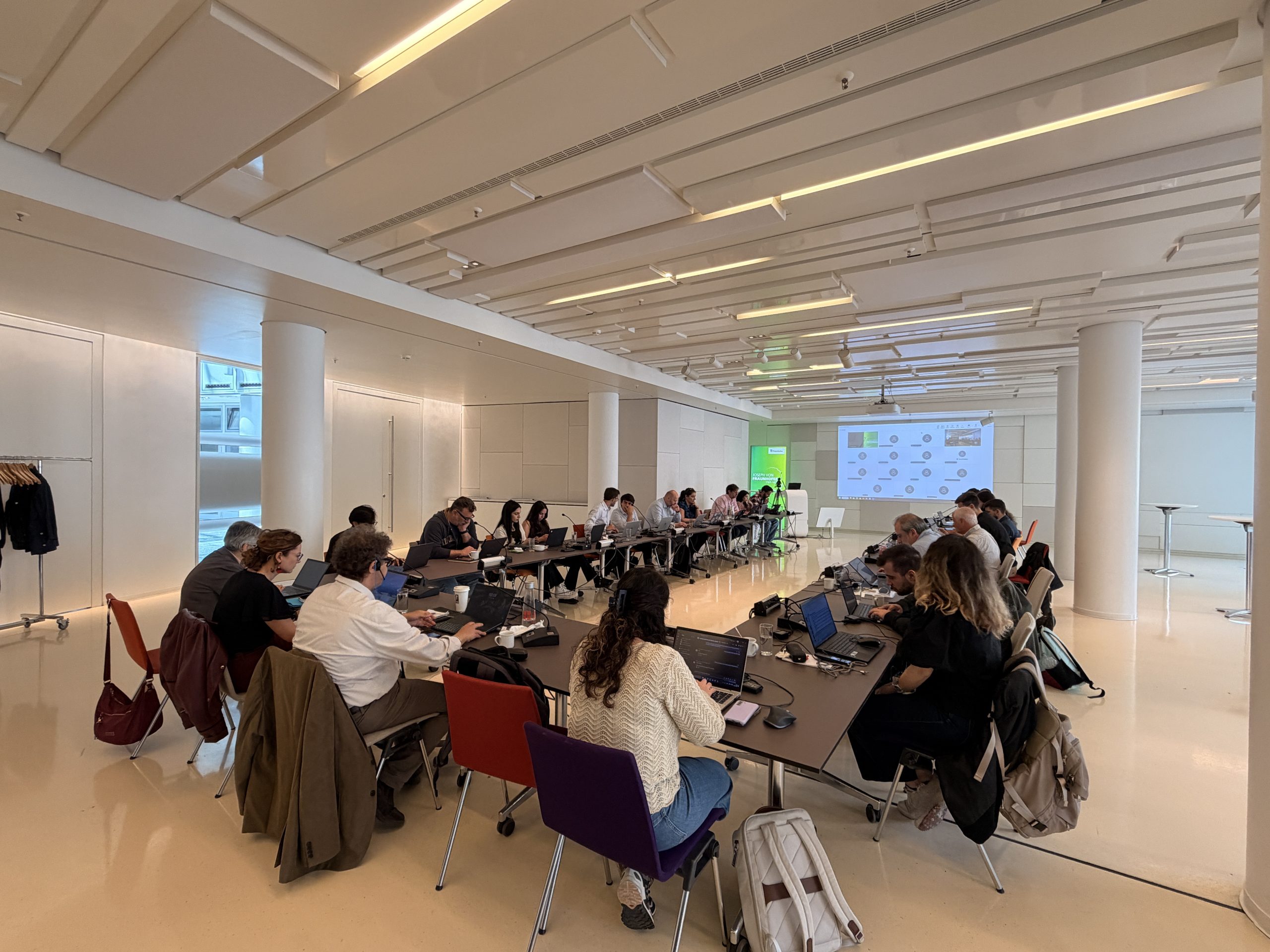
The third PQ-NEXT General Assembly Meeting was held in Berlin, Germany, on 19th and 20th May 2026. Hosted by Fraunhofer at their premises in the vibrant centre of Berlin, all the PQ-NEXT partners from across Europe gathered to present their progress, coordinate future work, and strengthen the collaboration that enables the smooth transition to the post-quantum era.
The first day started with Project Management activities, covering timelines, deliverables, and the coordination tools used to keep the consortium aligned. The day continued with the remaining technical work packages and discussions on Migration Modelling Tools, Post Quantum Transition Enablers, and Large Scale Pilot Demonstrators. It ended with a lengthy discussion on synergies and exploitation, followed by a social dinner to conclude the first day.
Wednesday focused on the project’s legal aspects, impact, and outreach activities. The Legally Compliant Migrations work package addressed the regulatory and compliance landscape that any real-world transition must navigate. The day concluded with the Dissemination, Communication, and Exploitation work package, which covered how the project will share its findings with the research community, policymakers, organisations, and all interested stakeholders, as well as how to increase the project’s impact.
Two days, six work packages, and a room full of people working intensively to smooth and secure the post-quantum transition.
Stay tuned with the PQ-NEXT project and follow its social media channels!

PQ-NEXT core with Giulia Pastor and Marva Arampatzi, AUSTRALO
PQ-NEXT Core with Giulia Pastor and Marva Arampatzi, AUSTRALO
What drives PQ-NEXT from within? PQ-NEXT Core reveals the minds and teams behind the project. By showcasing the perspectives, insights, and ambitions of those leading its key areas, we uncover the vision and collaboration that shape PQ-NEXT’s vision.
Let’s start by getting to know Giulia Pastor and Marva Arampatzi, from AUSTRALO a little better.
I am Giulia Pastor, working in AUSTRALO and with my colleague Marva Arabatzi we are leading Work Package 6 Dissemination, Communication and Exploitation. I have a mixed background in political sciences, international relations and European affairs. After completing my BA and two MAs in Italy and France, I started working on EU-funded projects, initially focusing on administrative and financial management. Over time, I transitioned into communication and dissemination, and that’s where I realised I liked working closely with researchers and helping them translate complex scientific work into something more accessible and engaging.
“Scientists are experts in their fields but often need support in communicating their results to broader audiences. That’s where we, as science communication experts, come in — making sure that research doesn’t stay within academic circles, but reaches society as a whole”.
I am Marva Arampatzi, with a background in Marketing and International Business Management and over six years of experience working on EU projects, with a focus on dissemination and communication. What I enjoy most about working on EU projects is that, each time, depending on the project's topic, new challenges arise for me. One of them is the opportunity to explore a new scientific field by developing an understanding of the topic and then finding meaningful ways to make it accessible to people who, like me, come from outside that area of expertise.
You are the dissemination and communication partner for the PQ-NEXT project. What does this entail?
At AUSTRALO, we specialise in science communication, and in this project we lead WP6, which is the WP related to dissemination, communication, exploitation and standardisation. Specifically, we are in charge of the communication and dissemination activities, as well as the collaboration with other initiatives (such as the SPQR cluster). We work on a range of activities, including promoting the project to a wide range of stakeholders and ensuring that technical results are shared effectively in line with open science principles.
As I mentioned, our work is built around two main pillars: communication and dissemination. Communication focuses on raising awareness about the project, its objectives and its progress; dissemination, on the other hand, is about sharing scientific results with targeted audiences, including researchers and potential end-users.
A big part of our work also involves engaging with diverse audiences, from scientists and end users to the general public. Each group requires a different communication approach, which makes our jobs both challenging and interesting. Imagine explaining a complex, technical topic like post-quantum cryptography to the general public: it requires clarity, patience, and the ability to translate abstract concepts into relatable ideas.
We also led the D&C team for the PQ-REACT project, so we will utilise the knowledge gained from that project to enhance our activities and make the promotion of this project even more engaging!

Moving on, a personal note. What is the main outcome you personally hope this project will achieve?
Giulia: One of the most exciting results of the PQ-NEXT project is the development of a practical migration framework that assists governments, telecom providers, financial institutions, and critical infrastructure operators in transitioning safely from current encryption systems to post-quantum cryptography. Instead of focusing solely on theory, the project is creating real-world tools, hybrid cryptographic solutions, and large-scale pilot deployments to prepare Europe for the quantum era.
Additionally, this project brings together professionals from diverse backgrounds and expertise, so, as dissemination and communication leader, I am eager to promote the work behind it, transforming their complex activities into clear and engaging materials and campaigns!
Marva: For me, I hope this project will help raise awareness of the post-quantum transition in a way that feels relevant and understandable to everyone. Cybersecurity is something that affects all of us in our daily lives, and I believe that informed communities are better equipped to navigate the changes ahead.
Looking ahead, what excites you most about the post-quantum era?
Giulia: As someone with a social science background, it is fascinating to be part of a team of researchers, scientists, and experts working at such a transformative moment in the evolution of security technologies. It gives me the opportunity to witness real change, to see how technology develops and moves in the right direction: safeguarding people. Because in the digital world, protecting data means protecting people.
Marva: What I look forward to most is witnessing how this transition will shape our everyday lives, from the way we communicate and share information, to how we trust the digital systems around us, especially nowadays, when almost all of our everyday activities are becoming digital. It is one thing to work on something at a project level, but seeing it eventually reflected in the real world, in ways that people can feel and benefit from, is what makes this work truly worthwhile.

PQ-NEXT core with Marta Fernández, Sploro
PQ-NEXT Core with Marta Fernández, Sploro
What drives PQ-NEXT from within? PQ-NEXT Core reveals the minds and teams behind the project. By showcasing the perspectives, insights, and ambitions of those leading its key areas, we uncover the vision and collaboration that shape PQ-NEXT’s vision.
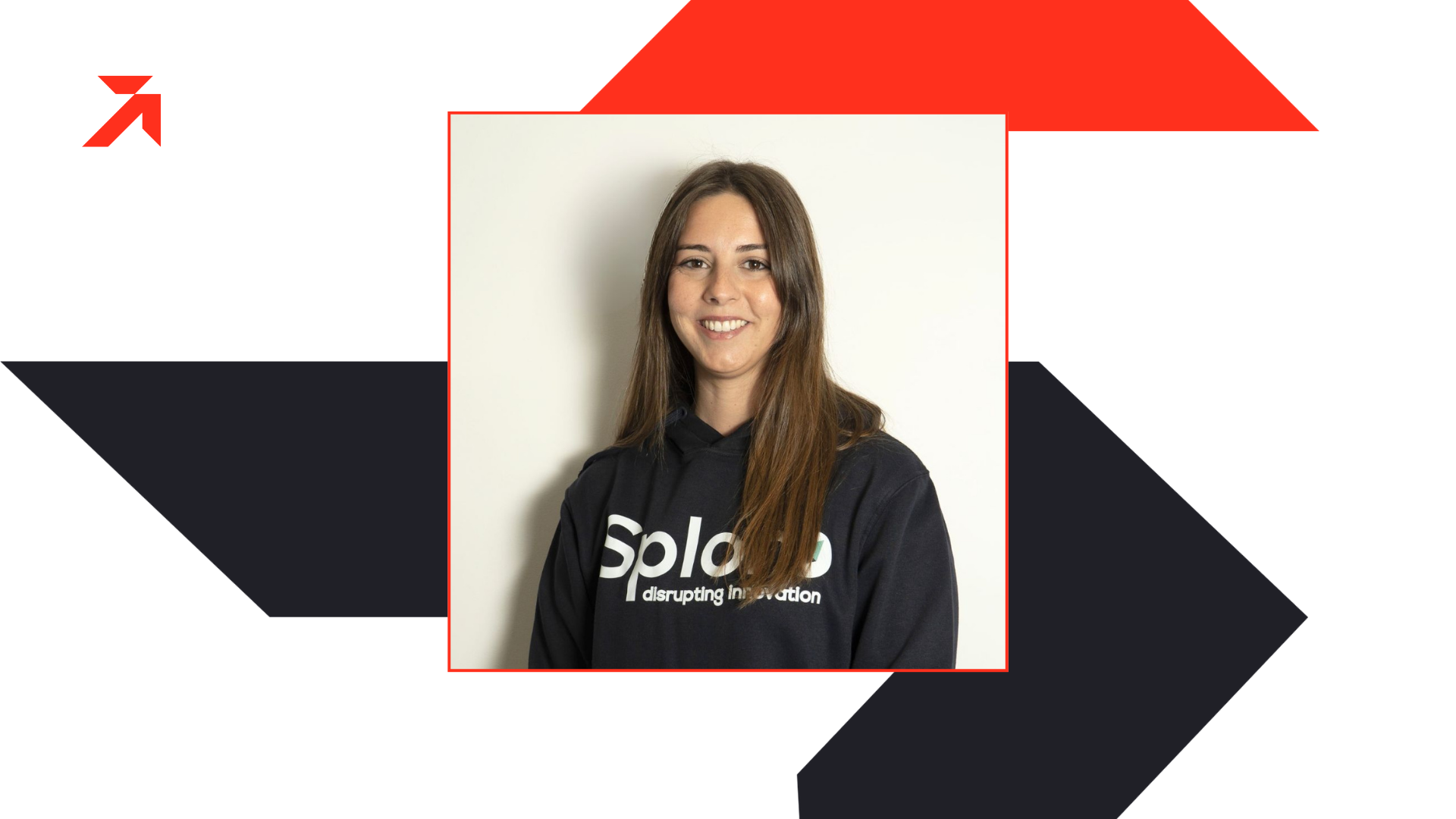
Let’s start by getting to know Marta Fernández, from Sploro, a little better and by introducing the team that will work on the project.
My name is Marta Fernández, and I am a European project manager at Sploro, a consultancy firm based in Pamplona, in the north of Spain. Sploro specialises in cascade funding mechanisms and exploitation activities, among other things.
I studied International Relations in Madrid and later completed a Master's in European Democracy and Human Rights. Over time, I specialised in the management of European projects, which is the role I bring to PQ-NEXT.
Within the project, I will be working as project manager alongside two colleagues: Virgínia Gómez, who is Head of the European Projects Department at Sploro, and Maya Horvat, another EU project manager who will work closely with me.
What motivated you to join this EU-wide consortium?
Our motivation to join PQ-NEXT was a natural evolution of the work we had already begun. Prior to PQ-NEXT, Sploro collaborated with several of the consortium partners on PQ-REACT. PQ-NEXT is, in that sense, a continuation and expansion of the work started in that previous project, which is how we came to be here.
What problem does your role in the project address in simple terms, and why is it critical for the project’s implementation?
PQ-NEXT aims to close a significant gap that Europe is currently facing. The encryption that protects almost everything we do in the digital world is based on classical computer mathematical algorithms. The transition to post-quantum cryptography is about making our digital security safer and, crucially, making that new security more user-friendly and accessible to everyone, not just large organisations.
Within PQ-NEXT, Sploro serves as the exploitation manager. In the previous project (PQ-REACT), we worked on selecting companies to run pilots on post-quantum cryptography topics. Now, the goal is to spread the knowledge generated by PQ-NEXT more broadly, using tools such as the migration toolbox being developed by the technical partners to make the transition easier for both large and small users, and to validate this across real-world pipelines.
“Now, the goal is to spread the knowledge generated by PQ-NEXT more broadly, using tools such as the migration toolbox being developed by the technical partners to make the transition easier for both large and small users, and to validate this across real-world pipelines.”
What are the main activities, tasks, and objectives of your work? And How is your work connected to the other tasks and activities?
Sploro leads exploitation activities within Work Package 6 “Dissemination, Communication and Exploitation”, which also covers dissemination and communication. Specifically, we work on Task 6.3 — Innovation Management and Exploitation Sustainability. This task encompasses several core activities:
1. Joint Exploitation: Developing a shared exploitation strategy for the project as a whole, alongside individual exploitation strategies tailored to each partner's profile and outputs.
2. Market Research and Business Modelling: Conducting market research that will feed into a business model and go-to-market strategy for the project's exploitable assets.
3. Knowledge Transfer and Upskilling: Developing knowledge transfer materials and upskilling resources for end users who will benefit from the post-quantum cryptography tools produced by the project. This is the activity I consider most important.
Exploitation does not happen in a vacuum; it is deeply connected to every part of the project. For our exploitation roadmap to be meaningful, we need to fully understand what the technical partners are building, including the migration toolbox and the algorithm catalogue. We work closely with the pilot leaders and also with the dissemination team, who build the project ecosystem and communication strategy that our exploitation activities build upon.
“We work closely with the pilot leaders and also with the dissemination team, who build the project ecosystem and communication strategy that our exploitation activities build upon.”
Moving on, a personal note. What is the main outcome you personally hope this project will achieve?
My hope is perhaps more grounded in a general user perspective than a technical one. I think the most important thing we can deliver is something that everyone can use, a clear and accessible pathway for organisations of all sizes to move from traditional security methods to post-quantum cryptography.
This should not be something only large corporations with existing expertise can benefit from. Municipalities, small businesses, and any organisation working with sensitive data should be able to make this transition. Making that transition genuinely accessible to all would be the most meaningful result of this project.
“I think the most important thing we can deliver is something that everyone can use, a clear and accessible pathway for organisations of all sizes to move from traditional security methods to post-quantum cryptography.”
Looking ahead, what excites you most about the post-quantum era?
Coming from a non-technical background, what excites me most is reading the European Commission's roadmap for the coming years and seeing the level of commitment to citizens' security. The way in which the transition to post-quantum security is being approached, and the fact that a major institution like the European Commission is actively driving it, is what I find most encouraging. Having a region genuinely committed to protecting its citizens' digital security is something worth being excited about.
“The way in which the transition to post-quantum security is being approached, and the fact that a major institution like the European Commission is actively driving it, is what I find most encouraging.”

PQ-NEXT Core with Giovanni Comandè, SmartLex/Scuola Superiore Sant'Anna
PQ-NEXT Core with Giovanni Comandè, SmartLex/Scuola Superiore Sant'Anna
What drives PQ-NEXT from within? PQ-NEXT Core reveals the minds and teams behind the project. By showcasing the perspectives, insights, and ambitions of those leading its key areas, we uncover the vision and collaboration that shape PQ-NEXT’s vision.
Let’s start by getting to know Giovanni Comandè, from SmartLex/Scuola Superiore Sant'Anna, a little better and by introducing the team that will work on the project.
My name is Giovanni Comandè. I am a full professor of law at the Scuola Superiore Sant'Anna in Pisa, and also the founder of SmartLex, which is also a partner in the PQ-NEXT project. My background is in law, and I have completed my degree at the Scuola Superiore Sant'Anna and, for research purposes, have joined Harvard Law School and various other universities across the world, on topics related to law and technology that are directly relevant to our work in PQ-NEXT.
The SmartLex team is multidisciplinary. Alongside several jurists, we have technical experts, including informaticians, data scientists, and AI developers. It is a mixed team that joins the wider multidisciplinary consortium PQ-NEXT, and we will all be working closely with the other project partners.
What motivated you to join this EU-wide consortium?
The primary motivation was the challenges set out in the call and, above all, the way our consortium proposed to address them. This project is, in a sense, a follow-up to earlier work in which we began to devise transition strategies for the post-quantum era. PQ-NEXT goes further, requesting the actual development of pragmatic tools, and that is exactly what we are doing. The consortium is also well-equipped and well-balanced to meet the objectives of the project. That was the main reason for joining.
“The primary motivation was the challenges set out in the call and, above all, the way our consortium proposed to address them.”
What problem does your role in the project address in simple terms, and why is it critical for the project’s implementation?
SmartLex contributes at two distinct levels within the project.
First, under Work Package 1 “Project Management”, SmartLex is responsible for ethics compliance across the overall project. This includes monitoring ethics issues that may arise and maintaining attention to gender balance and gender-related matters throughout the project’s lifecycle.
Second, and more substantially, SmartLex, together with Scuola Superiore Sant'Anna, leads Work Package 5 “Framing and implementing legally compliant migrations” on the legal dimensions of the post-quantum transition. This involves developing a comprehensive mapping of the legal constraints and compliance requirements that apply to organisations transitioning to post-quantum cryptography. From this mapping, and through ongoing interaction with the technical partners, we are developing a proof of concept for an intelligent compliance and navigation system. The goal is to empower all entities required to transition to the post-quantum era to do so in a compliant way, helping them identify and navigate their specific compliance needs.
“The goal is to empower all entities required to transition to the post-quantum era to do so in a compliant way, helping them identify and navigate their specific compliance needs.”

What are the main activities, tasks, and objectives of your work? And How is your work connected to the other tasks and activities?
Our work operates at two levels of interaction with the rest of the project.
At the first level, we conduct what is typically called desktop research, analysing legal rules in light of case law (primarily from the European Union), scholarly contributions, and policy documents, and transforming this analysis into a practical mapping useful to our technical partners. This mapping is developed in close collaboration with the other partners in Work Package 5 and is continuously refined in view of their use cases and technical developments.
At the second level, there is recurring interaction with several work packages across the project. The most direct connection is with Work Package 2, where the core technical solutions and the platform are being developed. We provide legal feedback for that work and receive input in return in a continuous series of loops.
For ethics compliance, we maintain a similar ongoing feedback process. Through monthly working group meetings and general consortium meetings, we monitor any emerging ethics issues and raise awareness among the other partners of potential concerns affecting their work, addressing them proactively as the project progresses.
There is also collaboration with Scuola Superiore Sant'Anna on Task 5.3, which addresses insurance components and risk management.
Moving on, a personal note. What is the main outcome you personally hope this project will achieve?
I hope that as a project and as a team, we can help strengthen the EU's position in the post-quantum era. More specifically, I hope our work contributes to offering a benchmark grounded in fundamental rights protection. This feels especially important at a time when the rule of law, the role of international institutions, and trust between peoples, states, and institutions are being severely tested.
The key outcome I really hope our consortium brings about is something useful not only for the European Union, though it would certainly strengthen the EU's position, but something that could be taken up more broadly worldwide.
“I hope that as a project and as a team, we can help strengthen the EU's position in the post-quantum era.”
Looking ahead, what excites you most about the post-quantum era?
Despite all the work that has already been done in this field, I think we are still not fully aware of what the post-quantum era will truly mean, the incredible opportunities and the significant challenges, both for good and for ill, are not yet fully perceived or described.
What is genuinely exciting is the opportunity, with a great team, truly a team of teams, to contribute to shaping the post-quantum era in a positive direction: towards a future that is peaceful, environmentally friendly, respectful of human and fundamental rights, and secure in cybersecurity terms. The goal is to minimise and, where possible, prevent the darker risks that lie ahead.
Technology is not inherently good or bad; it is defined by the uses we make of it. What excites me is the possibility of helping to steer the post-quantum era towards the benefit of humankind and reducing the significant risks that come with it. We should not be afraid of advanced technology, but we must be equipped to navigate it wisely. That is precisely why the legal dimension is so important in this project.
“Technology is not inherently good or bad; it is defined by the uses we make of it.”

PQ-NEXT Core with Laura Domínguez Céspedes, Telefónica Innovación Digital
PQ-NEXT Core with Laura Domínguez Céspedes, Telefónica Innovación Digital
What drives PQ-NEXT from within? PQ-NEXT Core reveals the minds and teams behind the project. By showcasing the perspectives, insights, and ambitions of those leading its key areas, we uncover the vision and collaboration that shape PQ-NEXT’s vision.
Let’s start by getting to know Laura Domínguez Céspedes, from Telefónica Innovación Digital, a little better and by introducing the team that will work on the project.
I am Laura Domínguez Céspedes, currently working as a Network Security Analyst at Telefónica Innovación Digital (R&D) located in Madrid, which I joined in 2024. My work focuses on securing the next generation of communication networks, with particular attention to emerging challenges in quantum and post-quantum security.
Regarding my academic background, I have a master's degree in Telecommunications Engineering from the Polytechnic University of Valencia, Spain, as well as a degree in Telecommunications from the University of Alicante.
My expertise closely aligns with the objectives of the PQ-NEXT project, as I have been actively involved in several research and innovation initiatives related to quantum key distribution (QKD) and post-quantum cryptography (PQC), including EUROQCI-SPAIN, PQ-REACT, and PQ-NEXT.
Through this work, I have gained experience in evaluating secure communication architectures, contributing to the integration of quantum-safe technologies into transport networks, and analysing potential vulnerabilities in evolving cryptographic systems.
As for the team, the project is led by Antonio Pastor, a senior expert, and brings together a multidisciplinary group of researchers and engineers with expertise in network security, cryptography, and advanced communications. Consisting of Mattin Elorza Forcada and Víctor Hernando Fernández, who have previously collaborated on research projects such as PQ-REACT or QUBIP.
What motivated you to join this EU-wide consortium?
The aspect that has motivated me the most to join this European Union-wide consortium is the opportunity to collaborate with both industry and research communities. Our goal is to address the challenges of the post-quantum transition by developing and validating solutions that can be practically implemented in real-world settings.
What problem does your role in the project address in simple terms, and why is it critical for the project’s implementation?
My role focuses on deploying and orchestrating quantum-secure and hybrid security solutions in a real operator network. In simple terms, the problem to be solved is to address the transition to post-quantum security in live Telco environments without disrupting our clients' services.
“My role focuses on deploying and orchestrating quantum-secure and hybrid security solutions in a real operator network”
What are the main activities, tasks, and objectives of your work?
The main activities and objectives of our Work Package 4 “Large Scale Pilot Demonstrators” focus on the deployment, integration, and validation of the PQ-NEXT framework across four large-scale pilot environments. Specifically, WP4 includes:
• Prepare a complete integration and validation plan for each pilot testbed. This includes defining the workflow, the required components, and the KPIs that will be used to evaluate performance and security.
• Execution of Pilot Trials, where each pilot leader will deploy the PQ-NEXT framework in realistic operational environments and execute the trials. The goal is to measure and demonstrate the practical benefits of quantum-safe technologies in each scenario.
• Validation of quantum and postquantum cryptography mechanisms and the associated security architectures, ensuring they meet the performance requirements relevant to each use case and sector.
• Verification of how PQC and QKD impact both security KPIs and service KPIs across the pilots. This allows us to identify realistic, practical, and scalable quantum-resistant transition paths.
All previous tasks will be articulated around four pilot-specific tasks:
• Pilot 1 – PQC transition in financial environments
• Pilot 2 – Quantum secure orchestration in a Telco network
• Pilot 3 – Quantum resistant crypto for critical infrastructure
• Pilot 4 – Quantum safe digital documents and identity for municipal services
How is your work connected to the other tasks and activities?
In addition to developing Telco network pilot 2, we are also the leaders of the work package, therefore, we have to ensure that everything is integrated correctly.
Moving on, a personal note. What is the main outcome you personally hope this project will achieve?
I personally hope that this project will deliver a clear, practical, and validated roadmap for the real-world transition to postquantum cryptography across different sectors. Specifically, in terms of migrating widely used protocols to integrate PQC and QKD, such as NETCONF/RESTCONF/TLS, etc. And, to provide implementation best practices that organisations can adopt to carry out a safe, realistic, and cost-effective quantum-resistant migration.
“I personally hope that this project will deliver a clear, practical, and validated roadmap for the real-world transition to postquantum cryptography across different sectors.”
Looking ahead, what excites you most about the post-quantum era?
Looking ahead, what interests me the most about the post-quantum era is the opportunity to actively contribute to and work within a transformative period for security technologies. It is especially motivating to witness how the solutions we develop in innovation projects are increasingly being adopted in real-world production environments, driving meaningful advancements in secure communications.
“It is especially motivating to witness how the solutions we develop in innovation projects are progressively making their way into real-world production environments.”
What it means for a young professional working on such large EU projects
I believe that working on large EU projects as a young professional has allowed me to learn and mature professionally in parallel while advancing projects and technology.
How this could impact your career
Something very important that I think can impact and benefit me in working on these projects is knowing what a project with a two- or three-year timeline is like from the beginning, and learning from all its phases, collaborating with multidisciplinary teams from various sectors.

PQ-NEXT Core with René Zander, Fraunhofer FOKUS
PQ-NEXT Core with René Zander, Fraunhofer FOKUS
What drives PQ-NEXT from within? PQ-NEXT Core reveals the minds and teams behind the project. By showcasing the perspectives, insights, and ambitions of those leading its key areas, we uncover the vision and collaboration that shape PQ-NEXT’s vision.
Let’s start by getting to know René Zander from Fraunhofer FOKUS a little better and by introducing the team that will work on the project.
My name is René Zander, and I'm a quantum computing scientist at Fraunhofer FOKUS, where I have been working for almost three years. Prior to that, I completed my Master's and PhD in mathematics at TU Berlin, specialising in dynamical systems and discrete integral systems.
At Fraunhofer FOKUS, I work across a range of quantum computing topics, including quantum algorithms research, quantum benchmarking, and post-quantum cryptography. I am also a developer of the high-level programming language Eclipse QRISP, which we have been developing over several years and continue to develop through the PQ-NEXT project and several other European and German-funded projects.
My mathematical background is directly relevant to this work, cryptography mechanisms at their core rely on mathematics. RSA cryptography relies on the hardness of factorising numbers into prime factors, while post-quantum cryptography relies on different mathematical problems, such as finding shortest vectors in lattices. When it comes to testing the security of PQC algorithms and developing quantum algorithms that could attack them, a strong mathematical foundation is essential.
On this project, I am mainly working alongside my colleague Tobias Köppel, who is also a mathematician with a background in differential equations. Together, we use our knowledge in mathematics and programming to contribute to PQ-NEXT, specifically within Work Package 3 “Post-Quantum Cryptanalysis Enablers”.
What motivated you to join this EU-wide consortium?
It is a great opportunity to work with partners from across Europe, get to know different institutions, countries, and people through European projects, and share knowledge and gain different perspectives. Some consortium partners are more focused on use cases, while we come from a more theoretical side. That mix of expertise is valuable.
It is also an opportunity to find new collaborators for Eclipse CRISP, which is an open-source quantum programming language. We have already had contributions from colleagues at AGH in Kraków, and working within a European consortium like this opens further doors for collaboration.
“It is also an opportunity to find new collaborators for Eclipse CRISP, which is an open-source quantum programming language.”
What problem does your role in the project address in simple terms, and why is it critical for the project’s implementation?
The core problem we address is that post-quantum cryptography methods are relatively new and therefore less tested than established cryptography, such as RSA or elliptic curve cryptography. During the NIST standardisation process, which took place over several years, some proposed algorithms that were believed to be secure against quantum attacks turned out not to be secure, even against classical attacks in some cases.
Our work, therefore, enables researchers to use quantum computers to implement and test attacks against these new post-quantum cryptography mechanisms. The goal is to increase our confidence in the security of these algorithms before they are widely deployed.
“Our work, therefore, enables researchers to use quantum computers to implement and test attacks against these new post-quantum cryptography mechanisms.”
What are the main activities, tasks, and objectives of your work? And how is your work connected to other tasks and activities?
Work Package 3, titled Post-Quantum Cryptanalysis Enablers, aims to enable testing of PQC algorithms against quantum attackers. It is divided into three tasks:
1. Quantum Software Stack Development — We will further develop the Eclipse CRISP library to ensure seamless compilation of large-scale quantum attacks. This involves ensuring that all relevant algorithms for attacking post-quantum cryptography are fully compatible with our JAX-based compilation pipeline. To address scalability limitations of Python-based quantum programming, we use an intermediate representation approach with MLIR-based compiler technology.
2. Quantum Algorithm Research — This task focuses on researching quantum algorithms that could be used to attack post-quantum cryptography. We will look at optimisation algorithms such as the Quantum Approximate Optimisation Algorithm (QAOA), linear system solvers, and other quantum algorithms, and investigate how they could be applied to quantum cryptanalysis.
3. Post-Quantum Programming Suite — The third task involves implementing and testing a post-quantum programming suite. This tool, built on top of the Eclipse CRISP library, will allow researchers to easily test different PQC mechanisms against quantum attacks, providing a suite of cryptographic primitives paired with a suite of quantum attackers.
In terms of connections to the wider project, Work Package 3 is closely related to Work Packages 2, PQ-NEXT Migration Modelling Tools, and Work Package 4, Large Scale Pilot Demonstrators. Work Package 2 identifies which PQC algorithms are relevant and should be used; the inventory of cryptographic primitives it produces feeds directly into our testing work in Work Package 3. Our findings can then serve as a basis for Work Package 2 and inform Work Package 4 on which algorithms should be used in practical applications. We collaborate particularly with Indra, the University of Athens, and AGH Kraków within this work package.
Moving on, a personal note. What is the main outcome you personally hope this project will achieve?
Any new insights into the security of PQC algorithms or the identification of vulnerabilities would be a great outcome. Of course, the primary goal of the work package is to deliver the post-quantum programming suite that enables benchmarking of PQC algorithms and seeing that tool used in practice would be a very meaningful result.
“Any new insights into the security of PQC algorithms or the identification of vulnerabilities would be a great outcome.”
Looking ahead, what excites you most about the post-quantum era?
The exciting part is really the challenge of transitioning to post-quantum cryptography before fault-tolerant quantum computers capable of breaking traditional RSA or elliptic curve cryptography become a reality. As a mathematician, I am also genuinely excited to work on the underlying mathematical problems and investigate them further.
It is worth noting that post-quantum cryptography itself does not offer new utility; it simply replaces existing cryptographic methods with ones that will be safe against quantum attacks. The real excitement lies in ensuring this transition happens in due time.
More broadly, quantum computing is a fascinating field because of its many potential applications in areas such as quantum chemistry and quantum physics research.