
PQ-NEXT Core: Bringing PQ-NEXT into higher education
What drives PQ-NEXT from within? This time, we sat down with our academic partners to discuss their role and contributions to the PQ-NEXT project.
Let’s meet and greet with the Universidad Politécnica de Madrid. We will discover the university, the background, the team and the journey that led them in PQ-NEXT.
The team brings together Vicente Martín, Full Professor and Deputy Director of the CSS, whose expertise spans quantum communications, QKD, quantum networks and their integration into telecommunications and security infrastructures; Laura Ortiz, Permanent Labour Professor, whose research focuses on beyond-QKD protocols, quantum metrology and enhancing QKD networks with new functionalities; Javier Faba, Assistant Professor, specialising in quantum information, quantum communication networks, entanglement distribution and beyond-QKD protocols; and Juan Pedro Brito, Permanent Labour Professor, who brings extensive experience in QKD research and the integration of quantum technologies with advanced networking paradigms such as SDN and NFV.
The UPM team’s research lines include the characterisation and integration of QKD systems in quantum networks; deployment of real quantum-communication infrastructures (notably, the team have deployed the largest QKD network in Europe to date); programmable quantum network control (software-defined networking for QKD); integration with classical cryptographic services (e.g., TLS, VPN, IPSec); modelling of current and future-proof quantum-communication networks; and new services and protocols beyond QKD (e.g., quantum-entanglement distribution networks, multiparty quantum secret sharing, entropy distribution, etc.). The team also focuses on knowledge transfer, including proof-of-concept demonstrations with industry, standardisation and entrepreneurship training. 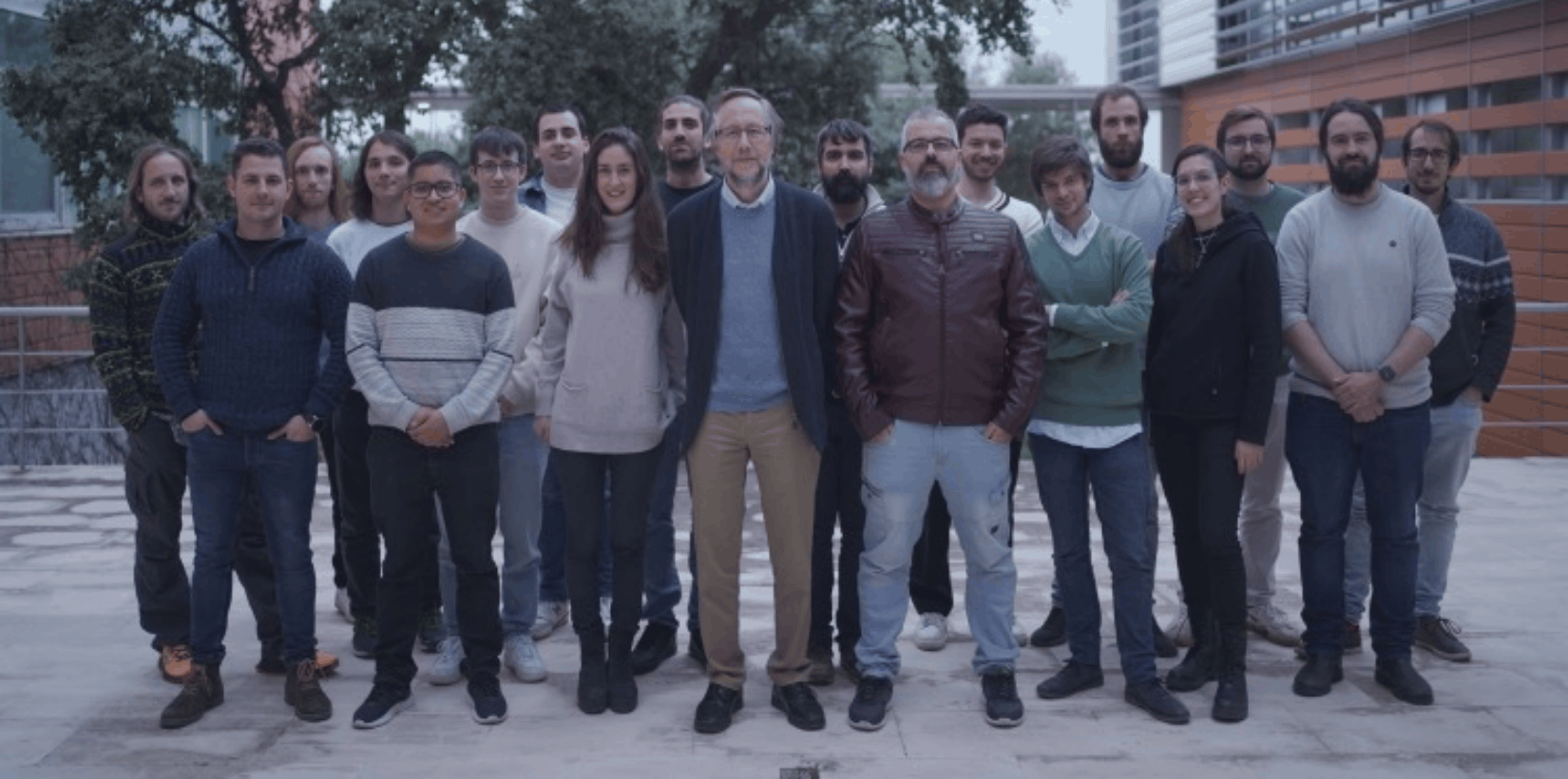
The Universidad Politécnica de Madrid and its role within PQ-NEXT
As a key academic and research partner based in Spain, Universidad Politécnica de Madrid (UPM) leverages a rich background from participating and leading European and national initiatives—such as PQ-REACT, QUBIP, MadQuantum-CM, EuroQCI-SPAIN or QSNP, among others—to advance quantum-resistant security solutions. Within the PQ-NEXT project, UPM’s primary focus centers on leading the design, integration, and practical execution of a pilot demonstrator covering realistic Telco network scenarios, serving as a real-world testing ground for quantum-resistant communications. Surrounding this central effort, UPM applies its expertise in post-quantum algorithm evaluation, hybrid schemes, and standardisation, while actively supporting workforce development through high-quality training and educational resources to prepare the European ecosystem for a secure quantum transition.
How does your work in PQ-NEXT influence your teaching activities and curriculum development?
Our work in PQ-NEXT directly updates our curriculum by incorporating cutting-edge research on post-quantum algorithms and hybrid cryptography. Real-world insights and data from the project’s large-scale pilot deployments enrich our expertise and bring us closer to a secure quantum-safe transition.
What skills should today’s students develop to be ready for the post-quantum era?
To be prepared for the post-quantum era, today’s students must develop a deeper understanding of quantum mechanics applied specifically to quantum computing and quantum communications. Furthermore, they need stronger cybersecurity expertise to effectively apply these principles to modern communication systems.
How can students participate in quantum-safe cybersecurity research at your institution, and, in particular, in the PQ-NEXT project?
Students who have high motivation and a strong interest in quantum cybersecurity are welcome to join our research group through Final Degree or Master’s thesis projects, as well as research opportunities.
How does collaboration with industry partners within PQ-NEXT enrich academic research?
Collaboration between industry partners and academia is essential for driving a successful real-world transition to quantum-safe cybersecurity. While academic institutions provide theoretical rigour and advanced cryptographic research, industry partners offer concrete use cases and operational constraints. This synergy enriches academic research by grounding theoretical concepts in real-world application, ensuring that post-quantum security frameworks are tested against practical market challenges, and accelerating the translation of scientific innovation into scalable, deployable solutions.
What excites you most about the future impact of PQ-NEXT?
What excites us most about the future impact of PQ-NEXT is the opportunity to gain invaluable knowledge and conduct real-world testing that will bring us significantly closer to a quantum-safe transition—a step that is absolutely crucial for ensuring secure communications in this era.