

PQ-NEXT Core: Into Research Institutions-the ATHENA Research Center
PQ-NEXT Core: Into Research Institutions-the ATHENA Research Center
What drives PQ-NEXT from within? This time, we sat down with our partners from our research institutions to discuss their role and contributions to the PQ-NEXT project.
Let’s meet and greet the ATHENA Research Center. We will explore their background, team, and the journey that led them to PQ-NEXT.
I am Ilias Politis, a researcher at the Industrial Systems Institute (ISI) of the ATHENA Research Center in Greece. My background is in communications, networks and cybersecurity, and much of my work has focused on how we can build digital systems that are not only efficient, but also secure, resilient and trustworthy. In PQ-NEXT, I participate as Principal Investigator and leader of TAQOS Team (www.taqos.eu), our research team within ISI. TAQOS brings together people working on cybersecurity, quantum and post-quantum technologies, secure software, distributed systems and digital infrastructures. PQ-NEXT is a very natural fit for us because it brings several of these areas together. The move towards post-quantum security is not simply a cryptography problem. It affects software, networks, infrastructure and the way organisations design and maintain secure systems.
What is the role of the ATHENA Research Center within PQ-NEXT?
ATHENA is a research centre focusing on information, communication and knowledge technologies. Within ATHENA, the Industrial Systems Institute has a strong applied-research orientation, working on technologies that can eventually move from the laboratory into real systems. Our TAQOS team works across several connected areas: quantum and post-quantum engineering, cybersecurity, secure and interoperable data systems, resilient distributed systems, and secure-by-design development and validation. In PQ-NEXT, our main focus is on the transition to post-quantum security. We contribute to quantum software and post-quantum security assessment, but also to the tools and methods that can help organisations understand how to migrate their existing systems. This combination is important to us. We are interested not only in developing new technologies, but also in understanding how they can be integrated, tested and trusted in practice.
How does your work in PQ-NEXT influence your activities related to education and research on post-quantum cryptography?
ATHENA is a research centre rather than a university, so our connection with education is mainly through collaboration with universities, student supervision, research fellowships, seminars and thesis work. Projects such as PQ-NEXT give us the opportunity to bring very current research topics directly to students and young researchers. Post-quantum cryptography, quantum programming and crypto-agility are developing very quickly, so it is valuable for students to encounter them through real research problems rather than only through textbooks. This is something that is important more generally for TAQOS as well. Our work spans several emerging areas, from quantum technologies and cybersecurity to trustworthy AI and secure distributed systems, and we want young researchers to see how these fields connect to each other.
What skills do you believe today's students should develop to be ready for the post-quantum era?
Good foundations are still the most important thing. Students need to understand cybersecurity, cryptography, networking and software engineering. But they should also become familiar with post-quantum cryptography and the basic ideas behind quantum computing. Not everyone needs to become a quantum physicist or a cryptographer, but future cybersecurity professionals should understand why quantum computing changes some of the assumptions we rely on today. I would also emphasise practical skills: programming, testing, systems integration and the ability to evaluate how a technology behaves in a real environment. Perhaps most importantly, students should learn to work across disciplines. The post-quantum transition will require people who can understand both the security problem and the systems in which the solution has to operate.
How can students participate in quantum-safe cybersecurity research at your institution, and, in particular, in the PQ-NEXT project?
There are several ways students and young researchers can become involved with us, including Master's and PhD theses, research fellowships and positions connected with European and national research projects. Within TAQOS, the range of possible topics is quite broad. Someone may work on post-quantum cryptography and migration, quantum software, secure development, resilient networks, distributed systems or cybersecurity testing and validation. PQ-NEXT is particularly interesting because it allows young researchers to see the complete picture. They can work on a technical problem, but also understand how that work connects to larger systems and real application environments. And PQ-NEXT is not isolated within our team. TAQOS is also involved in a number of HORIZON EUROPE projects such as SecQDevOps and Q-VERSE, which address secure quantum software engineering, development workflows and quantum runtime technologies. Together, these projects create a broader research environment around quantum and post-quantum systems.
How does collaboration with industry partners within PQ-NEXT enrich your research?
For us, as a Research Centre, collaboration with industry is essential because it keeps research connected to real needs. In the laboratory, we may focus on whether a security mechanism is theoretically sound or whether a new technology works. An organisation deploying it has additional questions: How much does it cost? Does it slow the system down? Will it work with existing infrastructure? Can we migrate without interrupting important services? PQ-NEXT brings research organisations together with partners from areas such as telecommunications, finance and critical infrastructure. That interaction helps us understand where the real difficulties are. It also fits very well with the way TAQOS works. We are interested in building prototypes, architectures and validation environments that help turn research ideas into solutions that can eventually be used outside the research community.
What excites you most about the future impact of PQ-NEXT?
What I find most interesting is that PQ-NEXT looks at post-quantum security as a transition, not simply as the replacement of one cryptographic algorithm with another. Organisations first need to understand where cryptography is being used, what is at risk, what needs to change and how that change can happen safely. They then need tools for migration, testing and validation. That is also very close to the philosophy of TAQOS. We work on quantum and post-quantum engineering, but always with the wider system in mind, asking how technologies are developed, how they interact, how are they tested and how can we trust them? If PQ-NEXT can provide organisations with practical tools and methods for making that transition, while also advancing our understanding of quantum-enabled security assessment, then I think it can have an impact well beyond the project itself.


PQ-NEXT Core: Bringing PQ-NEXT into higher education-the case of UPM
PQ-NEXT Core: Bringing PQ-NEXT into higher education
What drives PQ-NEXT from within? This time, we sat down with our academic partners to discuss their role and contributions to the PQ-NEXT project.
Let’s meet and greet with the Universidad Politécnica de Madrid. We will discover the university, the background, the team and the journey that led them in PQ-NEXT.
The team brings together Vicente Martín, Full Professor and Deputy Director of the CSS, whose expertise spans quantum communications, QKD, quantum networks and their integration into telecommunications and security infrastructures; Laura Ortiz, Permanent Labour Professor, whose research focuses on beyond-QKD protocols, quantum metrology and enhancing QKD networks with new functionalities; Javier Faba, Assistant Professor, specialising in quantum information, quantum communication networks, entanglement distribution and beyond-QKD protocols; and Juan Pedro Brito, Permanent Labour Professor, who brings extensive experience in QKD research and the integration of quantum technologies with advanced networking paradigms such as SDN and NFV.
The UPM team’s research lines include the characterisation and integration of QKD systems in quantum networks; deployment of real quantum-communication infrastructures (notably, the team have deployed the largest QKD network in Europe to date); programmable quantum network control (software-defined networking for QKD); integration with classical cryptographic services (e.g., TLS, VPN, IPSec); modelling of current and future-proof quantum-communication networks; and new services and protocols beyond QKD (e.g., quantum-entanglement distribution networks, multiparty quantum secret sharing, entropy distribution, etc.). The team also focuses on knowledge transfer, including proof-of-concept demonstrations with industry, standardisation and entrepreneurship training. 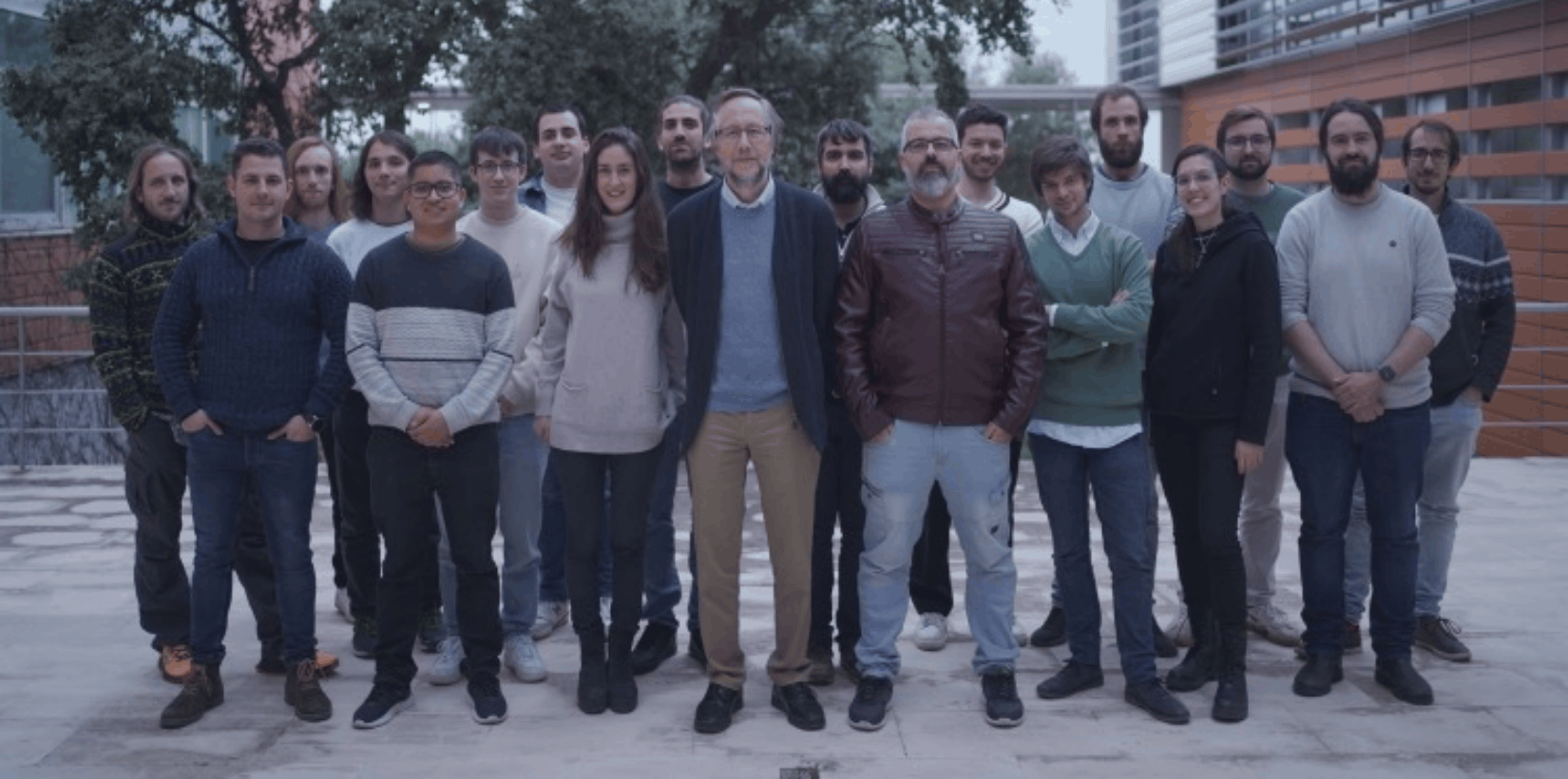
The Universidad Politécnica de Madrid and its role within PQ-NEXT
As a key academic and research partner based in Spain, Universidad Politécnica de Madrid (UPM) leverages a rich background from participating and leading European and national initiatives—such as PQ-REACT, QUBIP, MadQuantum-CM, EuroQCI-SPAIN or QSNP, among others—to advance quantum-resistant security solutions. Within the PQ-NEXT project, UPM’s primary focus centers on leading the design, integration, and practical execution of a pilot demonstrator covering realistic Telco network scenarios, serving as a real-world testing ground for quantum-resistant communications. Surrounding this central effort, UPM applies its expertise in post-quantum algorithm evaluation, hybrid schemes, and standardisation, while actively supporting workforce development through high-quality training and educational resources to prepare the European ecosystem for a secure quantum transition.
How does your work in PQ-NEXT influence your teaching activities and curriculum development?
Our work in PQ-NEXT directly updates our curriculum by incorporating cutting-edge research on post-quantum algorithms and hybrid cryptography. Real-world insights and data from the project's large-scale pilot deployments enrich our expertise and bring us closer to a secure quantum-safe transition.
What skills should today's students develop to be ready for the post-quantum era?
To be prepared for the post-quantum era, today's students must develop a deeper understanding of quantum mechanics applied specifically to quantum computing and quantum communications. Furthermore, they need stronger cybersecurity expertise to effectively apply these principles to modern communication systems.
How can students participate in quantum-safe cybersecurity research at your institution, and, in particular, in the PQ-NEXT project?
Students who have high motivation and a strong interest in quantum cybersecurity are welcome to join our research group through Final Degree or Master’s thesis projects, as well as research opportunities.
How does collaboration with industry partners within PQ-NEXT enrich academic research?
Collaboration between industry partners and academia is essential for driving a successful real-world transition to quantum-safe cybersecurity. While academic institutions provide theoretical rigour and advanced cryptographic research, industry partners offer concrete use cases and operational constraints. This synergy enriches academic research by grounding theoretical concepts in real-world application, ensuring that post-quantum security frameworks are tested against practical market challenges, and accelerating the translation of scientific innovation into scalable, deployable solutions.
What excites you most about the future impact of PQ-NEXT?
What excites us most about the future impact of PQ-NEXT is the opportunity to gain invaluable knowledge and conduct real-world testing that will bring us significantly closer to a quantum-safe transition—a step that is absolutely crucial for ensuring secure communications in this era.

PQ-NEXT Core: The Pilot Edition-Motor Oil Hellas
PQ-NEXT Core: The Pilot Edition-Motor Oil Hellas
Discover the PQ-NEXT Pilots
The PQ-NEXT solutions will be validated through large-scale pilots across the finance, critical infrastructure, telecommunications, and digital identity sectors, leveraging selected digital twin use cases. Throughout this blog series, we will take a closer look at each pilot, exploring its objectives, implementation, expected outcomes, and its role in advancing the transition to post-quantum security.
The Motor Oil Hellas Pilot
Pilot 3: Application of Quantum Resistant Crypto to Critical Infrastructure deployments
The Pilot
Pilot 3 “Application of Quantum-Resistant Cryptography to Critical Infrastructure deployments” is led by Motor Oil, with NCSR Demokritos, INDRA, Telefónica Innovación Digital and AFCEA as contributors. Its scope is to demonstrate how post-quantum cryptography can secure operational technology, smart metering and energy-network components in a representative refinery and energy critical-infrastructure environment. To do this safely, the pilot is built around a digital twin of Motor Oil’s testbed, a parallel, production-like environment in which hybrid PQC can be deployed, exercised and measured without any risk to live operations.
The Why
What is the problem the pilot will address, the sector motivation, and the quantum threat rationale?
Critical infrastructure depends on classical public-key cryptography (such as RSA and elliptic-curve) to protect VPNs, firmware updates, authentication and the exchange of sensitive operational data. A future cryptographically-relevant quantum computer would break these schemes, and because operational data and assets have very long lifetimes, the “harvest-now, decrypt-later” risk makes the threat effectively present today. For the energy sector the stakes are high: disruption to essential services has wide societal impact, and obligations such as NIS2 raise the bar for resilience. At the same time, operators cannot simply switch cryptography on live systems, because availability and safety must be preserved at all times. Pilot 3 addresses exactly this gap and it provides a safe, representative environment in which Motor Oil, as an industrial operator, can confront the quantum threat early and plan a controlled migration.
The How
The technical approach, deployment environment, tools, and expected outcomes
The technical approach is to reproduce Motor Oil’s critical-infrastructure network as a digital twin, replicating the real communication paths, routers, firewalls and field devices, including the PLC, the SCADA monitoring system, the Historian database, the pressure sensors and the smart-metering components. Within this environment we deploy hybrid post-quantum cryptography, combining CRYSTALS-Kyber for key establishment and CRYSTALS-Dilithium for digital signatures alongside classical algorithms. The deployment is implemented over StrongSwan (an IPsec-based VPN) using the liboqs library across the relevant application protocols, with the PQ-NEXT toolbox providing the cryptographic support to the OT components.
Three operational use cases are exercised: reading data from the field sensors, sending commands to the pump, and importing or exporting logs to and from the Historian. For each, we assess quality, latency, scalability and energy consumption against two headline KPIs, keeping the additional communication latency introduced by PQC below 50 ms for key exchanges and firmware updates, and supporting at least a 20% increase in the number of devices without performance degradation. The expected outcomes are validated, quantitative evidence that hybrid PQC can run in an OT environment with acceptable operational impact, together with reusable deployment profiles, a KPI methodology and lessons learned. These feed the project’s validation and simulation suite and its network-security enablers, and inform best practice for the wider critical-infrastructure sector.
PQ-NEXT Core: The Pilot Edition - Telefónica Innovación Digital
PQ-NEXT Core: The Pilot Edition - Telefónica Innovación Digital
Discover the PQ-NEXT Pilots
The PQ-NEXT solutions will be validated through large-scale pilots across the finance, critical infrastructure, telecommunications, and digital identity sectors, leveraging selected digital twin use cases. Throughout this blog series, we will take a closer look at each pilot, exploring its objectives, implementation, expected outcomes, and its role in advancing the transition to post-quantum security.
The Telefónica Innovación Digital Pilot
Pilot 2: Quantum-secure orchestration on a Telco Network
The Pilot
In recent years, networks have evolved into infrastructures that are more complex than they used to be, with multi-domain architectures, network programmability (SDN or NFV), and even the inclusion of AI-based automation. This is the scenario in which Pilot 2, Quantum-secure orchestration on a Telco Network, will be developed. This use case will evaluate the transition of network Operation and Management (OAM) to quantum-secure solutions. This pilot will identify the protocols and tools involved in the management plane and demonstrate the transition solution for the critical protocols. This scenario will select relevant domains in telco networks (cloud, transport, access, interconnection, etc.) and apply the best transition approach based on PQC and QKD hybridization.
This use case will be developed by TID in collaboration with UPM, using real infrastructure, since part of it will be developed and tested on a segment of MadQCI (Madrid Quantum Communication Infrastructure) in order to extract relevant information from real networks.
The Why
What is the problem the pilot will address, the sector motivation, and the quantum threat rationale?
Telecommunications networks have now reached a very high level of complexity, with many components depending on one another, including multi-domain architectures, IoT devices, and even the use of AI for automation. This creates significant security challenges, since with so many components involved, a vulnerability in just one of them may put the entire network at risk.
The threat posed by quantum attacks is particularly sensitive for telecommunications networks, as they are built upon highly heterogeneous infrastructures involving multiple vendors, technological domains, equipment generations, and software releases. This complexity is further increased by the fact that network infrastructures continuously evolve, while some components progressively become legacy systems. In many cases, these legacy devices may not be included in vendors’ quantum-safe migration roadmaps, leaving operators dependent on third-party decisions and timelines. As a result, the transition to post-quantum technologies may introduce interoperability challenges, some devices may become incompatible with others during the transition to post-quantum technologies is carried out.
Another issue that has been identified is that the roadmaps for the post-quantum transition of network equipment manufacturers are very long-term, which means that we currently cannot be certain how networks will behave once the transition to post-quantum technologies takes place. Moreover, since the telecommunications networks are already in operation, any update towards PQC-based solutions is particularly sensitive and must first be tested on a small-scale laboratory environments before being introduced into production networks. For this reason, it is very important to start carrying out this type of testing on a smaller scale in order to validate the transition.
With this use case, we aim to understand how the post-quantum transition will affect the quality of service provided by current networks, in order to fully understand all the implications it brings and to help define a set of recommendations and a roadmap for how the transition should be implemented while minimizing its impact on the current infrastructure.
The How
The technical approach, deployment environment, tools, and expected outcomes
To carry out the use case, quantum-safe implementations of the different protocols used in telecommunications networks will be tested, using standardized PQC algorithms and QKD. The pilot will test not only the security of the protocols, but also the deployment of a PKI system that uses PQC algorithms and hybridization based on the ACME (RFC 8555) and ACME-STAR standard (RFC 8739).
Another aspect to be tested in this pilot is the use of solutions that enable not only interoperability between quantum-safe solutions across devices from different manufacturers, in order to avoid dependence on third parties, but also ways to secure the legacy parts of the networks; that is, to identify mechanisms to protect equipment that does not have the capability to implement post-quantum solutions.
All these tests will be carried out both in emulated environments and in real telecommunications network environments. For the real network, MadQCI (Madrid Quantum Communication Infrastructure) will be used; it is one of the largest quantum networks in Europe. All tests performed in these environments will be aimed at assessing the feasibility of the post-quantum transition in real networks.
With all this, the pilot aims to draw conclusions on how the post-quantum transition will affect the current communications network infrastructure, studying both its impact on the quality of service provided and the impact of integrating the systems required for the transition. As a result, it is expected to define a set of guidelines or recommendations on how to carry out the transition, taking into account the importance of ensuring crypto-agility in the systems.

PQ-NEXT Core with Danai Theochari, Motor Oil Hellas
PQ-NEXT Core with Danai Theochari, Motor Oil Hellas
What drives PQ-NEXT from within? PQ-NEXT Core reveals the minds and teams behind the project. By showcasing the perspectives, insights, and ambitions of those leading its key areas, we uncover the vision and collaboration that shape PQ-NEXT’s vision.
Let’s start by getting to know Danai Theochari, Motor Oil Hellas, a little better and by introducing the team that will work on the project.
My name is Danai Theochari, and I am a Cybersecurity Expert at Motor Oil Hellas (MOH). I represent the Cybersecurity department in PQ-NEXT, where MOH serves as the owner of Pilot 3. My background is in incident response, penetration testing, cyber defence and resilience, with more than 6 years of experience protecting the kind of OT and IT environments that underpin energy operations. Motor Oil is a diversified, integrated energy provider in Southeastern Europe: we operate one of the most complex refineries in Europe and rank among the leading suppliers of electricity, energy-efficiency and electromobility services in Greece.
The journey to PQ-NEXT began from a simple operational concern: the cryptography that protects our critical communications today will not withstand a future quantum computer, yet our assets and the data they exchange have very long lifetimes. Joining the consortium gave us the opportunity to confront that risk early and in a controlled way, and to make sure the post-quantum transition is shaped around the realities of an industrial operator rather than only in the laboratory.
The Motor Oil team working on PQ-NEXT is deliberately multidisciplinary, bringing together the competencies needed to validate post-quantum cryptography in a live industrial setting:
- OT and automation engineers, who understand the SCADA, PLC and field-device environment that the pilot reproduces;
- IT and network-security specialists, responsible for the digital twin, the VPN and the integration of post-quantum and hybrid cryptography;
- compliance and risk colleagues, who connect the technical work to our regulatory obligations under NIS2 and the GDPR.
Within the project, this team works closely with our Pilot 3 contributors, the coordinator NCSR Demokritos, together with INDRA Sistemas de Comunicaciones Seguras (ISCS), Telefónica Innovación Digital (TID) and AFCEA.
What problem does your role in the project address in simple terms, and why is it critical for the project’s implementation?
In simple terms, my role makes the project real. As the industrial end-user and leader of Pilot 3, Motor Oil contributes to the operational environment, the requirements and the validation that turn post-quantum cryptography from a promising idea into something an energy operator can actually deploy. The problem we address is that critical-infrastructure operators cannot experiment with new cryptography on live systems, availability and safety come first, so there has been no safe, representative place to find out what hybrid post-quantum protection really costs in latency, scalability and energy.
This is critical for PQ-NEXT’s implementation because the project’s credibility depends on evidence from a realistic setting. By building a digital twin of our own infrastructure, we let the consortium test, measure and refine its tools against genuine industrial constraints without ever touching production. Our role also anchors the work in the regulatory reality of the sector, NIS2 and the GDPR, so that the results are not only technically sound but defensible for operators who have to justify every change.
What are the main activities, tasks, and objectives of your work and your work in PQ-NEXT?
Our overall objective is to demonstrate that post-quantum cryptography can secure operational technology, smart metering and energy-network components against future quantum-enabled threats without unacceptable operational impact. Concretely, Motor Oil’s work spans several work packages:
- Leading the Critical Infrastructure Pilot (WP4, M8–M36): designing and building the digital twin, integrating PQC algorithms (Kyber, Dilithium), measuring latency and energy KPIs, validating performance and reporting results in the context of Pilot 3.
- Pilot integration and planning (WP4, M4–M10): defining pilot 3 requirements, KPIs and integration support so that our activities align with the overall WP4 validation and demonstration plan.
- Feedback on migration tools and benchmarking (WP2 & WP3, M6–M24): providing industrial validation and feedback for hybrid deployment and crypto-agility optimisation.
- Compliance and risk input (WP5, M10–M30): supplying GDPR and NIS2 insights to the legal-navigator and risk-management framework.
- Dissemination and standardisation (WP6, M18–M36): sharing pilot outputs and best practices with the wider community and standardisation activities.
Moving on, a personal note. What is the main outcome you personally hope this project will achieve?
On a personal level, what I most hope this project achieves is to turn the quantum threat from an abstract worry into a manageable engineering decision for operators like us. If, by the end of PQ-NEXT, a critical-infrastructure operator can look at our pilot and see a credible, evidence-based path for adopting hybrid post-quantum protection in stages, with real numbers on latency, scalability and energy, and a clear way to stay compliant, then we will have removed a great deal of the uncertainty that holds the sector back today. I would like the digital-twin approach we are validating to become a trusted, repeatable way to de-risk this transition, so that protecting essential energy services for the long term becomes a matter of routine good practice rather than a leap of faith.
Looking ahead, what excites you most about the post-quantum era?
What excites me most is crypto-agility, the shift from cryptography as a fixed, one-off choice to something we can adapt as the threat landscape and the standards evolve. For an energy operator that is genuinely empowering: instead of reacting to each new risk, we can design resilience into our communications from the outset and update it with confidence. I am also drawn to the idea that security and sustainability can advance together. PQ-NEXT explicitly measures energy impact, which matters a great deal to us as an energy company. More broadly, the post-quantum era is a chance for industrial operators to move from the back foot to being proactive, protecting the essential services that society depends on well before the threat fully materialises.

PQ-NEXT Core: The Pilot Edition - Municipality of Aigaleo
PQ-NEXT Core: The Pilot Edition - Municipality of Aigaleo
Discover the PQ-NEXT Pilots
The PQ-NEXT solutions will be validated through large-scale pilots across the finance, critical infrastructure, telecommunications, and digital identity sectors, leveraging selected digital twin use cases. Throughout this blog series, we will take a closer look at each pilot, exploring its objectives, implementation, expected outcomes, and its role in advancing the transition to post-quantum security.
The Municipality of Aigaleo Pilot
Pilot 4: Quantum-Safe Digital Documents and Identity for Municipality Services of Aigaleo using Quantum-Safe Blockchain and EBSI Integration
The Pilot
The pilot focuses on the digital issuance and verification of the Property Exact Address Certificate (Βεβαίωση Ακριβούς Διεύθυνσης Ακινήτου), a real municipal administrative service. Citizens submit an application either electronically or in person, the Municipality processes the request and issues the official certificate, which is represented as a Verifiable Credential (VC). The pilot demonstrates how post-quantum secure digital credentials can support trusted and future-proof municipal service delivery.
The Why
What is the problem the pilot will address, the sector motivation, and the quantum threat rationale?
Municipal administrations issue hundreds of official certificates every year, many of which are still processed using conventional document exchange and paper-based verification procedures. Citizens often need to present these documents repeatedly to different public authorities or organisations, while municipalities need to ensure the authenticity and integrity of the issued certificates.
The pilot addresses these challenges by demonstrating how a commonly requested municipal certificate can be issued as a digitally verifiable credential, simplifying verification while reducing administrative burden. At the same time, PQ-NEXT investigates how post-quantum cryptography can protect these digital credentials against future quantum-enabled attacks, ensuring the long-term trustworthiness of municipal digital services.
The How
The technical approach, deployment environment, tools, and expected outcomes
The pilot digitalises the existing municipal workflow without changing its administrative logic. A municipal officer registers the application, uploads the required supporting document, and issues an Application Receipt Verifiable Credential after the request is officially registered. Once the application has been processed, the Municipality issues the final Property Exact Address Certificate as a Verifiable Credential, which is stored in the citizen's digital wallet.
The solution is deployed within the Municipality of Aigaleo and integrates the PQ-NEXT credential management components with the municipal workflow. The pilot demonstrates secure credential issuance, wallet-based presentation, verification of Verifiable Presentations (VPs), and trusted certificate validation using post-quantum-ready cryptographic mechanisms. The expected outcome is a practical demonstration of secure, privacy-preserving and future-proof digital public service delivery that can be replicated by other municipalities.
PQ-NEXT Core with Dimitris Tzempelikos & Maria Gotzia, Municipality of Aigaleo
PQ-NEXT Core with Dimitris Tzempelikos & Maria Gotzia, Municipality of Aigaleo
What drives PQ-NEXT from within? PQ-NEXT Core reveals the minds and teams behind the project. By showcasing the perspectives, insights, and ambitions of those leading its key areas, we uncover the vision and collaboration that shape PQ-NEXT’s vision.
Let’s start by getting to know Dimitris Tzempelikos, from the Municipality of Aigaleo, a little better and by introducing the team that will work on the project.
My name is Dimitris Tzempelikos, and I am the Head of the Programming and Development Department of the Municipality of Aigaleo in Greece. I am a mechanical engineer with postgraduate studies in computational mechanics and applied informatics. Throughout my career in local government, I have been involved in the coordination and implementation of European projects related to smart cities, digital transformation, cybersecurity, advanced connectivity, climate resilience and innovative public services.
This experience gradually brought me closer to the field of cybersecurity and to the challenge of protecting public-sector digital services against emerging threats. Joining PQ-NEXT was therefore a natural next step, as the project connects advanced post-quantum technologies with practical applications that can directly benefit citizens and public administrations.
The Municipality of Aigaleo’s team in PQ-NEXT also includes Maria Gotzia, an IT Engineer, and Evridiki Pavlidi, a Social Scientist. Maria contributes her technical knowledge and supports the connection between the project’s technological solutions, the Municipality’s digital infrastructure and the operational requirements of the pilot. Evridiki contributes the social science and user-centred perspective, helping us consider the needs of citizens and municipal staff, as well as issues related to usability, accessibility, engagement and social impact.
Together, we form a multidisciplinary team combining project coordination, public administration, information technology and social science expertise. This allows us to connect the technical work of PQ-NEXT with the Municipality’s real administrative procedures and with the practical needs of both municipal officers and citizens.
What problem does your role in the project address in simple terms, and why is it critical for the project’s implementation?
In simple terms, our role is to ensure that the technologies developed by PQ-NEXT can work in a real municipal environment and not only under laboratory conditions. Municipalities issue official documents that citizens use in important administrative and legal procedures. These documents must remain authentic, secure and verifiable. As public services become increasingly digital, we must also consider whether today’s security mechanisms will remain reliable in the future, when quantum computers may be able to compromise some of the cryptographic methods currently in use.
Our role is critical because we provide the real administrative process, the practical requirements and the end-user perspective. We help the technical partners understand how a municipal service operates, what information is required, which steps must be followed and what constraints must be respected. Without this connection to the real operational environment, even a technically advanced solution may be difficult to deploy, use or replicate in public administration.
What are the main activities, tasks, and objectives of your work and your work in PQ-NEXT?
Our main objective is to support the design, implementation and validation of the Municipality of Aigaleo pilot.
The first activity is to analyse and document the existing process for issuing the Property Exact Address Certificate. This includes understanding how citizens submit their applications, how municipal officers register and assess each request, which supporting documents are required and how the final certificate is issued.
We then translate this administrative process into functional and technical requirements for the PQ-NEXT solution. We work closely with the technical partners to ensure that the Verifiable Credential components, the digital wallet and the post-quantum security mechanisms are properly integrated into the municipal workflow.
We will also support the deployment and testing of the solution, involve the relevant municipal officers and users, collect feedback and evaluate its usability, security and practical value.
Finally, we contribute to project coordination, reporting, dissemination and the replication of the pilot, so that the experience gained in Aigaleo can also be useful for other municipalities and public authorities.
Moving on, a personal note. What is the main outcome you personally hope this project will achieve?
Personally, I hope that PQ-NEXT will demonstrate that post-quantum security can move from highly specialised research into practical public services that citizens can understand and use.
For me, success would mean that a citizen can request an official municipal certificate, receive it securely in a digital wallet and present it to another organisation without unnecessary paperwork or repeated verification procedures. At the same time, the citizen should be confident that the certificate is authentic, privacy-preserving and protected for the long term.
I would also like the Aigaleo pilot to become a practical example that can be replicated by other municipalities. Local authorities often have limited technical and financial resources, so solutions must not only be secure but also realistic, interoperable and easy to adopt.
The most important outcome would therefore be increased trust: citizens trusting digital public services and public authorities being confident that their digital infrastructure is prepared for future security challenges.
Looking ahead, what excites you most about the post-quantum era?
What excites me most is the opportunity to prepare our digital infrastructure before the threat becomes an immediate crisis.
The transition to the post-quantum era is not simply about replacing one cryptographic algorithm with another. It gives us the opportunity to reconsider how digital trust, identity, authentication and secure information exchange are designed across public administration.
I am particularly interested in the potential of post-quantum technologies to protect digital identities and official credentials that may need to remain valid for many years. This is especially important for governments and municipalities, which manage information and documents with long-term administrative, legal and social value.
The post-quantum era can also encourage public organisations to become more adaptable and crypto-agile, meaning that their systems will be able to respond more quickly to new threats and security standards.
Ultimately, what excites me is the possibility of combining innovation with public value: using advanced technology to create digital services that are safer, simpler and more trustworthy for citizens.

PQ-NEXT Core: The Pilot Edition - CaixaBank
PQ-NEXT Core: The Pilot Edition - CaixaBank
Discover the PQ-NEXT Pilots
The PQ-NEXT solutions will be validated through large-scale pilots across the finance, critical infrastructure, telecommunications, and digital identity sectors, leveraging selected digital twin use cases. Throughout this blog series, we will take a closer look at each pilot, exploring its objectives, implementation, expected outcomes, and its role in advancing the transition to post-quantum security.
The CaixaBank Pilot
Pilot 1: Secure Transition to Post-Quantum Cryptography in Financial Environments
The Pilot
The CaixaBank pilot is the financial-sector pilot within the PQ-NEXT project, with CaixaBank acting as the pilot leader. The pilot brings together CaixaBank, CyberAId, and other PQ-NEXT partners to address one of the key challenges facing the financial industry: preparing for the transition to post-quantum cryptography.
The pilot focuses on gaining visibility into cryptographic assets deployed within a banking environment, assessing potential exposure to quantum-related risks, and evaluating technologies and methodologies that can support future migration to quantum-safe solutions.
As the pilot leader, CaixaBank provides the real-world banking use case, defines operational requirements, coordinates pilot activities, and validates the outcomes from a financial-sector perspective.
The Why
What is the problem the pilot will address, the sector motivation, and the quantum threat rationale?
The financial sector is one of the industries most dependent on cryptography. Banking services rely on cryptographic mechanisms to protect customer information, secure digital identities, authenticate transactions, and safeguard communications across complex technology ecosystems.
The emergence of large-scale quantum computing could eventually compromise some of the public-key cryptographic algorithms currently used throughout the financial industry. Although this threat is not immediate, preparing for it requires significant planning and a long-term strategy.
One of the biggest challenges organisations face today is understanding their existing cryptographic landscape. In large enterprises such as banks, cryptographic assets are often distributed across thousands of applications, systems, devices, certificates, and communication channels.
The pilot addresses this challenge by improving visibility into cryptographic usage and helping establish the foundations required for a future migration toward quantum-safe cryptography. The ultimate goal is to enable informed decision-making and improve the long-term resilience of financial services against emerging quantum threats.
The How
The technical approach, deployment environment, tools, and expected outcomes
The pilot combines CaixaBank's operational banking environment with CyberAId's cryptographic discovery and assessment capabilities, along with the expertise provided by the broader PQ-NEXT consortium.
The technical approach focuses on identifying and inventorying cryptographic assets across selected banking environments, including cryptographic algorithms, certificates, protocols, and associated dependencies. This information is analysed to understand potential exposure to quantum-related risks and to identify areas that may require future migration efforts.
CaixaBank evaluates the results from the perspective of a large financial institution, validating both the effectiveness of the discovery process and the usefulness of the generated insights for future planning.
The expected outcomes include increased visibility of cryptographic assets, a better understanding of quantum-related risks, the identification of migration priorities, and the definition of best practices that can support not only CaixaBank's quantum-readiness strategy but also the broader financial sector's transition toward quantum-safe security.

PQ-NEXT Core with Ramón Martín de Pozuelo, CaixaBank
PQ-NEXT Core with Ramón Martín de Pozuelo, CaixaBank
What drives PQ-NEXT from within? PQ-NEXT Core reveals the minds and teams behind the project. By showcasing the perspectives, insights, and ambitions of those leading its key areas, we uncover the vision and collaboration that shape PQ-NEXT’s vision.
Let’s start by getting to know Ramón Martín de Pozuelo from the CaixaBank, and by introducing the team that will work on the project.
My name is Ramon Martín de Pozuelo, and I work at CaixaBank, where I am involved in cybersecurity and innovation initiatives related to the protection of critical assets and emerging technology risks. Throughout my career at CaixaBank, I have had the opportunity to work on projects focused on strengthening the bank’s security posture, improving risk management capabilities, and supporting the adoption of new technologies in a secure and controlled manner. As cybersecurity evolves, the emergence of quantum computing has become one of the most important long-term challenges for the financial sector. This is what led us to PQ-NEXT. The project offers a unique opportunity to collaborate with leading European organizations, research institutions, and technology providers to better understand the impact of the quantum threat and prepare our infrastructure for the transition to post-quantum cryptography. Being part of this initiative allows us not only to assess future risks but also to contribute to practical solutions that will help protect financial services in the years ahead.
CaixaBank leads the financial-sector pilot within PQ-NEXT. Our team brings together professionals from cybersecurity, cryptography, technology architecture, infrastructure, and innovation areas. We work closely with the project partners to evaluate how quantum-safe technologies can be adopted within a large banking environment. As pilot leaders, our role is not only to provide the use case and deployment environment but also to help define requirements, validate results, and ensure that the proposed solutions address real-world challenges faced by financial institutions.
What problem does your role in the project address in simple terms, and why is it critical for the project’s implementation?
Our role focuses on helping ensure that the project addresses real operational and security needs from the perspective of a large financial institution.
The financial sector depends heavily on cryptography to secure transactions, customer data, authentication systems, and internal communications. Before organisations can migrate to post-quantum cryptography, they need a clear understanding of where and how cryptography is currently being used.
By providing business requirements, operational feedback, and access to realistic banking environments, we help ensure that the solutions developed within PQ-NEXT are practical, scalable, and aligned with the challenges that financial institutions will face during their quantum-safe transformation.
What are the main activities, tasks, and objectives of your work and your work in PQ-NEXT?
Our main objective is to assess how a large financial institution can prepare for the transition to post-quantum cryptography.
This involves identifying cryptographic assets, evaluating potential quantum-related risks, validating discovery and assessment tools, and understanding the operational impact of future migration activities.
As leaders of the financial-sector pilot, we also coordinate pilot activities, provide the banking use cases, and evaluate the effectiveness of the solutions being tested. Ultimately, our goal is to generate practical knowledge that can help both CaixaBank and the wider financial industry develop realistic strategies for achieving quantum readiness.
Moving on, a personal note. What is the main outcome you personally hope this project will achieve?
Personally, I hope PQ-NEXT helps transform post-quantum security from a theoretical discussion into a practical and actionable roadmap.
Many organisations understand that quantum computing may eventually impact current cryptographic systems, but translating that awareness into concrete actions remains a challenge. I would like this project to provide clear methodologies, best practices, and lessons learned that organisations could use to start their own transition journey with confidence
Looking ahead, what excites you most about the post-quantum era?
What excites me most is the opportunity to build the next generation of cybersecurity foundations.
The transition to post-quantum cryptography is one of the largest security transformations our industry has faced in decades. It requires collaboration between industry, academia, technology providers, and regulators. Being part of that transformation and helping shape a more resilient digital future for financial services is both an exciting and highly motivating challenge.

PQ-NEXT Core: Bringing PQ-NEXT into higher education- the case of HSRM
PQ-NEXT Core: Bringing PQ-NEXT into higher education- the case of HSRM
What drives PQ-NEXT from within? This time, we sat down with our academic partners to discuss their role and contributions to the PQ-NEXT project.
Let’s meet and greet the RheinMain University of Applied Sciences and Arts. We will discover the university, the background, the team and the journey that led them in PQ-NEXT.
The RheinMain University of Applied Sciences and Arts is a university in the city of Wiesbaden, the capital of the German state of Hesse. We have a strong research focus on smart cities, metropolitan networks, and the application of quantum technology in smart city infrastructures. For example, one of the pioneering QKD networks in Germany is currently being operated over a distance of around 7 km between RheinMain University of Applied Sciences and the Hessische Zentrale für Datenverarbeitung, the Hessian full-stack IT provider for public institutions.
Due to the interplay between public service infrastructures, smart cities, post-quantum cryptography, and specialised network expertise, we are the ideal partner to address the synergies between applied research and practical teaching within the PQ-NEXT project. Our long-term collaboration with various project partners has led to several ideas, which we hope to further develop and mature during the project.
The RheinMain University of Applied Sciences and Arts and its role within PQ-NEXT
As mentioned above, RheinMain University of Applied Sciences is a public university of applied sciences with a strong research focus and independent doctoral rights in fields such as computer science, mobility and logistics, and social sciences, among others. Within PQ-NEXT, we plan to work on migration strategies from traditional cryptography to post-quantum infrastructures. By involving two PhD students, we aim to make substantial contributions to the infrastructure migration kit in Work Package 2, thereby creating a practical tool for public institutions to support the migration of their networks and data centres toward resilient post-quantum cryptography.
How does your work in PQ-NEXT influence your teaching activities and curriculum development?
The university already offers many relevant courses, such as telecommunications networks, post-quantum cryptography, cybersecurity, digital government, and information and communication technology for smart cities. The participation in PQ-NEXT will help us to enhance excellence in teaching by creating a bridge between cutting-edge research and practical teaching for the engineers and computer scientists of the future. We plan to supervise bachelor’s, master’s, and PhD theses throughout the project, as well as offer practical student projects to complement our existing curriculum.
What skills should today's students develop to be ready for the post-quantum era?
Depending on their specific role, students would need skills in cryptography, public key infrastructures, network protocols and telecommunication infrastructures, data centres and cloud computing, as well as cybersecurity, risk management, and structured vulnerability analysis and penetration testing.
How can students participate in quantum-safe cybersecurity research at your institution, and, in particular, in the PQ-NEXT project?
Students will be involved in projects, as well as in bachelor’s, master’s, and PhD theses, with the additional opportunity to work on cutting-edge research as junior researchers in the participating research groups.
How does collaboration with industry partners within PQ-NEXT enrich academic research?
Collaboration with industry partners will help us align the applied aspects of our research more closely with practical needs and increase the relevance of our activities in the fields of smart cities and metropolitan network architecture. It will also support the transfer between fundamental research, applied teaching, and the use of future technologies within industries and companies in the RheinMain region of Germany.
What excites you most about the future impact of PQ-NEXT?
We are convinced that the PQ-NEXT research will have a major impact on the future of networks and data centres across Europe. The shift to new cryptographic schemes is inevitable, and the transition needs to be carefully prepared and systematically executed. This is exactly the area in which our PQ-NEXT research will support the future transition of our infrastructure.