
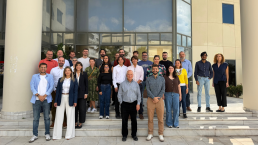
PQ-NEXT Welcomes Fall with its fourth General Assembly Meeting in Athens, Greece!
PQ-NEXT Welcomes Fall with its fourth General Assembly Meeting in Athens, Greece!
As we slowly enter our second year, our fourth General Assembly Meeting served as an introduction to the tools that we are developing, the methodologies to be implemented and the solutions needed for the smooth transition to the quantum era. With the wonderful hospitality of the Municipality of Egaleo, we gathered at their premises on 28-29 September 2026 in Athens, Greece, to discuss our progress, review the latest developments across the project’s solutions, and look ahead to the next steps.
But as we reflect back on our meeting, we wonder, “How is PQ-NEXT turning its research into solutions for the post-quantum transition? And how far have we reached?” A successful transition to post-quantum security requires more than adopting new cryptographic algorithms: it requires a clear understanding of existing infrastructures, risks, requirements and the different factors that can influence the migration process.
The PQ-NEXT PQC Algorithm Catalogue focuses on monitoring the current status, maturity, and development of quantum-resistant technologies. So far, we have an initial segmentation of the task into “building blocks” the catalogue needs to cover. This segmentation allows us to begin working on different objectives of the tasks, but further refinements are expected. Partners are enriching the catalogue with updates, and right now those updates have mostly happened at the algorithm specification level. As for the maintenance tools, they aim to support the PQC Migration Toolbox. Cryptographic inventory tooling and compliance auditing have been built as a server-client application. We are also designing and implementing an efficient quantum software stack, while analysing concepts and methods for a post-quantum programming suite.
One of the most important aspects of the project’s solutions is their validation in real-life pilots. We thoroughly presented and discussed all four pilots, including their progress and next steps before implementation. All pilots have their scenarios ready, and we are analysing the initial requirements.
- Pilot 1: Secure Transition to Post-Quantum Cryptography in Financial Environments
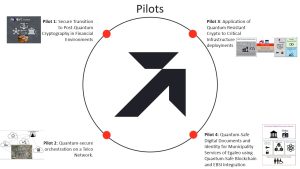
- Pilot 2: Quantum-secure orchestration on a Telco Network
- Pilot 3: Application of Quantum-Resistant Crypto to Critical Infrastructure deployments
- Pilot 4: Quantum-Safe Digital Documents and Identity for Municipality Services of Aigaleo using Quantum-Safe Blockchain and EBSI Integration
However, technology is not the only important aspect in the post-quantum transition. Organisations also need to understand the legal, regulatory and organisational implications of migration. The PQ-NEXT project also emphasises this. Mapping the regulatory framework around migration needs, with a specific focus on ensuring appropriate data flow integrated with cybersecurity compliance, has already started, and the map will continue to be enriched throughout the project’s duration. The PQ-NEXT team has thoroughly discussed and researched AI, data, and the consequences.
Of course, none of this work would ever reach our community without communication, dissemination, and exploitation. Strong online presence, scientific and awareness publications, key exploitable results and stakeholder engagement were topics that were presented, and more efforts will be put in place as the project results become more mature.
The progress achieved so far provides a strong foundation for the coming months. We look forward to bringing different results together, testing them under realistic conditions, and continuing to turn the project's research into solutions that can smooth and secure the post-quantum transition.
Join our quantum world and stay tuned!


How can a European project prepare banks, telecommunication companies, and secure our data in the quantum era? Meet PQ-NEXT
How can a European project prepare banks, telecommunication companies, and secure our data in the quantum era? Meet PQ-NEXT
Every time you pay online, log into your bank account, or send a message through a secure app, an invisible piece of mathematics protects you. Cryptography is the lock on almost everything digital. That lock has a well-known weakness, and our project is working to protect it before anyone can exploit it.
The problem
Much of today's internet security relies on mathematical problems that are extremely hard for classical computers. A classical computer would need an impractically long time to break these codes, so we know we can rely on them.
Quantum computers work differently. In the 1990s, mathematicians showed that a sufficiently powerful quantum computer could, in principle, break the most widely used public-key encryption systems. Such machines don't exist at that scale yet, and we do not know exactly when they will. However, the risk is real enough that security agencies and standards bodies worldwide are already acting.
In addition, there is also a new danger, called "harvest now, decrypt later". An attacker can copy encrypted data today and simply store it, waiting for the day quantum technology can unlock it. Medical records, state secrets and financial contracts that must stay confidential for decades are already exposed to that risk.
And now what?
Researchers have spent years developing post-quantum cryptography (PQC): new encryption methods designed to withstand both classical and quantum attacks. They run on ordinary computers and are based on different mathematical foundations.
The new locks are being designed. The challenge is integrating them into a world that has spent decades building on the old ones. Cryptography is deeply embedded everywhere: in our banking systems, telecom networks, city infrastructure, passports, and industrial machinery. Replacing it is less like changing a light bulb and more like replacing the plumbing in every building in a city while people still live in them without disrupting their everyday lives.
That is the gap PQ-NEXT aims to fill.
What PQ-NEXT is building
The project's core idea is a migration framework: a way to analyse and model different transition scenarios and produce tailored migration plans for different organisations. Alongside it, the PQ-NEXT team is assembling a catalogue of tools, including:
- PQC and hybrid algorithms. Hybrid schemes combine a classical method with a post-quantum one, so protection holds even if one proves flawed. New cryptographic ideas need time to earn trust, so this is a sensible safety net.
- Maintenance tools. Cryptography needs ongoing care: managing keys, updating algorithms, and keeping long-term data and communications trustworthy. The project's answer is crypto-agility, the ability to swap algorithms without rebuilding a whole system.
- A quantum programming language. It offers high-performance simulation and hybrid quantum-classical optimisation, giving researchers a way to work with quantum computing directly.
- A quantum cryptanalysis framework. To trust a new lock, you must try to pick it. This part of the project uses quantum computing techniques, focusing on future large-scale, fault-tolerant machines, to test and validate PQC algorithms.
PQ-NEXT into real-life applications
The project solutions will not stay in theory. They will be validated through large-scale, real-life pilots across a wide range of applications, including banking, critical infrastructure, telecommunications, and public services. Four pilots are planned to validate the PQ-NEXT results, namely:
Pilot 1: Secure Transition to Post-Quantum Cryptography in Financial Environments
Pilot 2: Quantum-secure orchestration on a Telco Network
Pilot 3: Application of Quantum-Resistant Crypto to Critical Infrastructure deployments
Pilot 4: Quantum-Safe Digital Documents and Identity for Municipality Services of Aigaleo using Quantum-Safe Blockchain and EBSI Integration
We carefully selected these to ensure a smooth transition to the coming quantum era, so we can continue our everyday digital activities without disruption and, most of all, securely.
Explore the PQ-NEXT pilots in detail
Why is PQ-NEXT’s research important?
And you're probably wondering: how should I prepare, or why should this topic matter to me? The truth is that individually we can’t prevent or undertake any actions. The change will come to our lives, and that is why we are grateful to our researchers. Because you will probably never see PQ-NEXT's work directly. But if it succeeds, your bank app will continue to operate securely, your digital ID will stay trustworthy, and your phone network will stay unaffected, without you noticing anything changed. Either way, the best security upgrades are invisible…
Join our quantum world and stay tuned!


PQ-NEXT Core: Into Research Institutions-the ATHENA Research Center
PQ-NEXT Core: Into Research Institutions-the ATHENA Research Center
What drives PQ-NEXT from within? This time, we sat down with our partners from our research institutions to discuss their role and contributions to the PQ-NEXT project.
Let’s meet and greet the ATHENA Research Center. We will explore their background, team, and the journey that led them to PQ-NEXT.
I am Ilias Politis, a researcher at the Industrial Systems Institute (ISI) of the ATHENA Research Center in Greece. My background is in communications, networks and cybersecurity, and much of my work has focused on how we can build digital systems that are not only efficient, but also secure, resilient and trustworthy. In PQ-NEXT, I participate as Principal Investigator and leader of TAQOS Team (www.taqos.eu), our research team within ISI. TAQOS brings together people working on cybersecurity, quantum and post-quantum technologies, secure software, distributed systems and digital infrastructures. PQ-NEXT is a very natural fit for us because it brings several of these areas together. The move towards post-quantum security is not simply a cryptography problem. It affects software, networks, infrastructure and the way organisations design and maintain secure systems.
What is the role of the ATHENA Research Center within PQ-NEXT?
ATHENA is a research centre focusing on information, communication and knowledge technologies. Within ATHENA, the Industrial Systems Institute has a strong applied-research orientation, working on technologies that can eventually move from the laboratory into real systems. Our TAQOS team works across several connected areas: quantum and post-quantum engineering, cybersecurity, secure and interoperable data systems, resilient distributed systems, and secure-by-design development and validation. In PQ-NEXT, our main focus is on the transition to post-quantum security. We contribute to quantum software and post-quantum security assessment, but also to the tools and methods that can help organisations understand how to migrate their existing systems. This combination is important to us. We are interested not only in developing new technologies, but also in understanding how they can be integrated, tested and trusted in practice.
How does your work in PQ-NEXT influence your activities related to education and research on post-quantum cryptography?
ATHENA is a research centre rather than a university, so our connection with education is mainly through collaboration with universities, student supervision, research fellowships, seminars and thesis work. Projects such as PQ-NEXT give us the opportunity to bring very current research topics directly to students and young researchers. Post-quantum cryptography, quantum programming and crypto-agility are developing very quickly, so it is valuable for students to encounter them through real research problems rather than only through textbooks. This is something that is important more generally for TAQOS as well. Our work spans several emerging areas, from quantum technologies and cybersecurity to trustworthy AI and secure distributed systems, and we want young researchers to see how these fields connect to each other.
What skills do you believe today's students should develop to be ready for the post-quantum era?
Good foundations are still the most important thing. Students need to understand cybersecurity, cryptography, networking and software engineering. But they should also become familiar with post-quantum cryptography and the basic ideas behind quantum computing. Not everyone needs to become a quantum physicist or a cryptographer, but future cybersecurity professionals should understand why quantum computing changes some of the assumptions we rely on today. I would also emphasise practical skills: programming, testing, systems integration and the ability to evaluate how a technology behaves in a real environment. Perhaps most importantly, students should learn to work across disciplines. The post-quantum transition will require people who can understand both the security problem and the systems in which the solution has to operate.
How can students participate in quantum-safe cybersecurity research at your institution, and, in particular, in the PQ-NEXT project?
There are several ways students and young researchers can become involved with us, including Master's and PhD theses, research fellowships and positions connected with European and national research projects. Within TAQOS, the range of possible topics is quite broad. Someone may work on post-quantum cryptography and migration, quantum software, secure development, resilient networks, distributed systems or cybersecurity testing and validation. PQ-NEXT is particularly interesting because it allows young researchers to see the complete picture. They can work on a technical problem, but also understand how that work connects to larger systems and real application environments. And PQ-NEXT is not isolated within our team. TAQOS is also involved in a number of HORIZON EUROPE projects such as SecQDevOps and Q-VERSE, which address secure quantum software engineering, development workflows and quantum runtime technologies. Together, these projects create a broader research environment around quantum and post-quantum systems.
How does collaboration with industry partners within PQ-NEXT enrich your research?
For us, as a Research Centre, collaboration with industry is essential because it keeps research connected to real needs. In the laboratory, we may focus on whether a security mechanism is theoretically sound or whether a new technology works. An organisation deploying it has additional questions: How much does it cost? Does it slow the system down? Will it work with existing infrastructure? Can we migrate without interrupting important services? PQ-NEXT brings research organisations together with partners from areas such as telecommunications, finance and critical infrastructure. That interaction helps us understand where the real difficulties are. It also fits very well with the way TAQOS works. We are interested in building prototypes, architectures and validation environments that help turn research ideas into solutions that can eventually be used outside the research community.
What excites you most about the future impact of PQ-NEXT?
What I find most interesting is that PQ-NEXT looks at post-quantum security as a transition, not simply as the replacement of one cryptographic algorithm with another. Organisations first need to understand where cryptography is being used, what is at risk, what needs to change and how that change can happen safely. They then need tools for migration, testing and validation. That is also very close to the philosophy of TAQOS. We work on quantum and post-quantum engineering, but always with the wider system in mind, asking how technologies are developed, how they interact, how are they tested and how can we trust them? If PQ-NEXT can provide organisations with practical tools and methods for making that transition, while also advancing our understanding of quantum-enabled security assessment, then I think it can have an impact well beyond the project itself.