

Happy Birthday PQ-NEXT!
Celebrate with us our one-year anniversary of building the foundations for a quantum-safe Europe
Building on the results of PQ-REACT, PQ-NEXT has spent its inaugural year initiating research activities, defining technical requirements and preparing the tools and pilots that will support Europe's transition towards a quantum-safe future. Now, as PQ-NEXT celebrates its first anniversary, it is time to look back at the progress made, the foundations established, and the work ahead!
From cryptographic migration and quantum cryptanalysis to real-world applications in finance, telecommunications, critical infrastructure, and digital identities, the first year has focused on laying the groundwork to turn a complex technological challenge into practical solutions.
During its first year, PQ-NEXT focused on establishing the technical foundations needed to support Europe's transition to post-quantum cryptography. Building on the results of PQ-REACT, the technical work has taken shape around three things: understanding the threat, measuring what the fix costs, and building the tools to make the move.
As we have already highlighted, the transition to post-quantum cryptography starts by understanding how cryptography works in each organisation. So it's not a process of just replacing existing algorithms, it’s a long procedure where organisations must have a clear picture of where and why they use cryptography and then explore how new solutions can be integrated into existing infrastructures, in order to prepare for a future in which quantum computers could challenge today's security mechanisms.
Our research compared Shor's algorithm, the best-known quantum threat to current public-key cryptography, with the newer Regev algorithm. In simulations, Regev's approach can outperform Shor's for certain numbers, though not in every scenario. That shows both its potential and how hard it is to use efficiently. There was also an implementation of a quantum algorithm for calculating square roots using reversible arithmetic, and it was run on a real quantum computer. It worked! This confirms the approach is practical, and it also showed how limited current machines still are.
Alongside this, our Fraunhofer team has been improving Qrisp, the high-level quantum programming framework, so that it can be used to analyse how quantum attacks perform against real cryptosystems. Compiling Qrisp programs was slow, so techniques were added to cut that time. They also implemented a Grover attack on lattice-based cryptosystems. The goal is to test how well different cryptosystems resist quantum attacks, so that people can decide which ones to rely on in the post-quantum era.
The new NIST-standardised algorithms are only useful if they run where they are needed. To check this, the research focused on ML-KEM, ML-DSA, and SLH-DSA from the liboqs library, which were then run on an ESP32 microcontroller, covering every parameter set NIST has standardised. Execution time was measured, key and signature sizes, and memory use. The conclusion is encouraging: the standardised algorithms are feasible even on small embedded systems, as long as you accept a trade-off between security level and performance.

Individual devices are only part of the picture, so we took our research further and explored what happens when post-quantum signatures are used inside a network protocol. A packet-level ns-3 simulator of a permissioned blockchain's ordering service was built, where every consensus message has to be authenticated. It models Raft, Paxos and a PBFT-inspired protocol over five network topologies. Signature costs were calibrated with liboqs and OpenSSL for ML-DSA, Falcon and SLH-DSA, and compared with classical schemes (Ed25519, ECDSA and RSA).
Knowing the threat and the cost still leaves a practical problem: an organisation has to find where its cryptography is and then change it. This is where most of the engineering effort has gone.
The project's catalogue of post-quantum algorithms was extended with the other half of the candidates from NIST's on-ramp signature process, so it keeps pace with standardisation. Our partners built a network traffic CBOM generator, which produces a cryptographic bill of materials: an inventory of the cryptography actually in use on a network. You can't migrate what you can't see, so this is where any migration starts.
On the network side, our CCIPS component has been integrated with the TeraFlowSDN controller, including a NETCONF-SSH southbound interface. Work is continuing on a post-quantum HTTPS southbound interface and on re-keying, together with gRPC integration and IPsec rekeying. The Migration Toolbox will bring all of this together, taking inputs from across the technical work and the pilots and turning them into a migration plan.
Our Real-world Testing
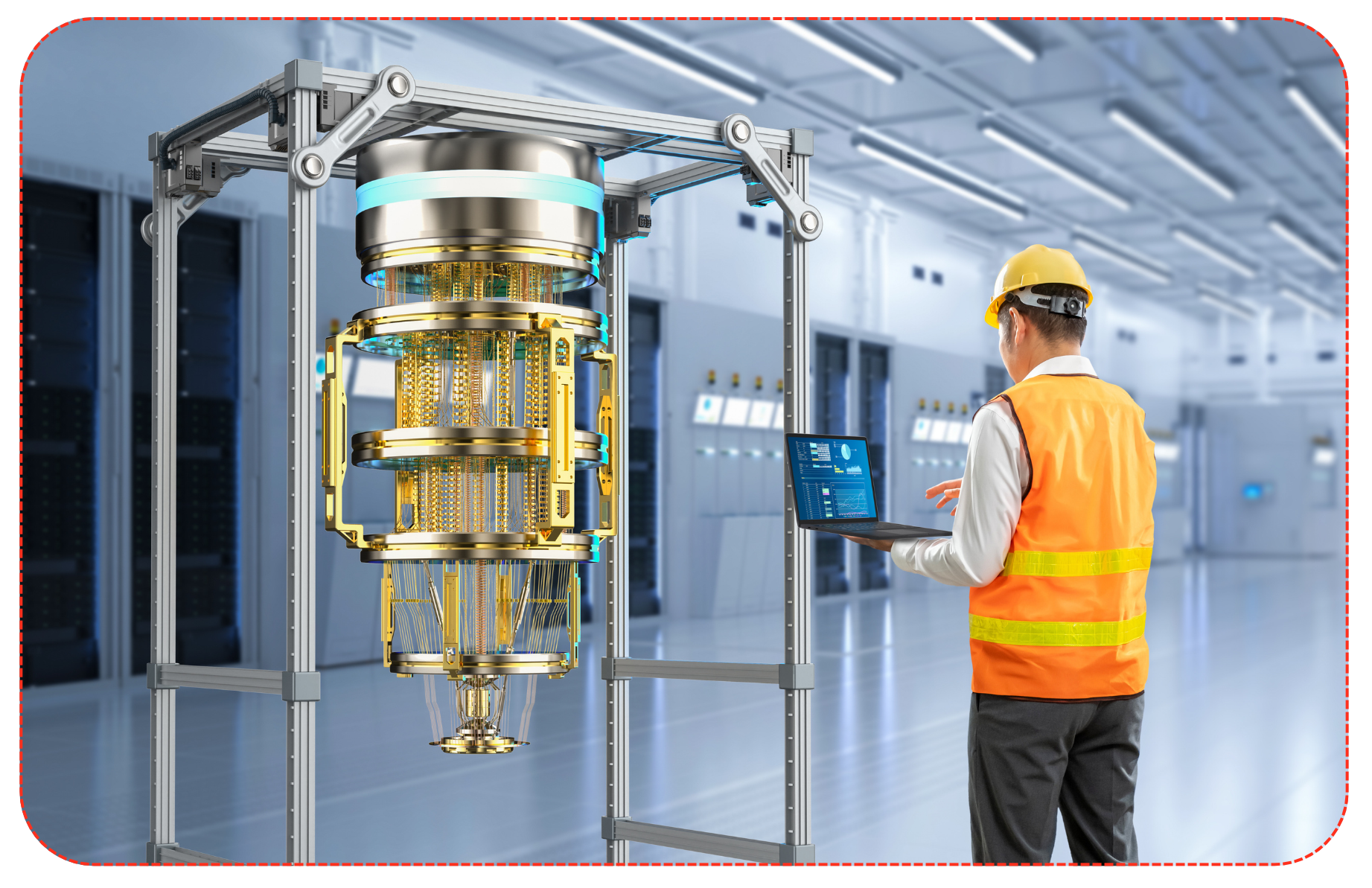
For PQ-NEXT, research is tested directly in real-life scenarios. A bank, a telecom operator, an energy company and a municipality are each testing post-quantum protection in their own environments. Our legal researchers are mapping what EU rules such as NIS2, the Cyber Resilience Act and DORA mean for organisations that delay migration, including the questions of liability and cyber insurance that follow.
Why it matters, and what comes next
Even though a quantum powerful computer capable of breaking today’s encryption does not exist yet, the threat is already out there. As we have previously explained, with the harvest now decrypt later, attackers collect encrypted data today and store them for later decryption. So the question is not why, but how. How can organisations join the quantum era safely without disruptions? Cryptography is built into countless systems, applications and communications, so the first challenge is simply finding where it is used and what to migrate first.
In its first year, PQ-NEXT worked on these problems and in the year ahead, the consortium will transition from system design to empirical validation. Our main technical objectives include:
Integrating the PQC Migration Toolbox
Unify core components into a cohesive, operational deployment suite.
Executing initial pilot deployments
Launch first-wave trials across target sectors using customised cryptographic migration strategies.
Benchmarking PQC primitives on next-generation quantum hardware
Evaluate algorithmic resilience and performance against emerging quantum infrastructure.
Disseminating empirical findings
Contribute validation data and technical insights to international standardisation bodies and the broader cybersecurity research community.

There could be no better conclusion than our partners' wishes for the year ahead!
INFILI: Happy Birthday, PQ-NEXT! Another year of advancing post-quantum cryptography and helping organisations prepare for a quantum-safe future!
AGH University of Krakow: On the occasion of our project's first anniversary, I wish us all patience with scientific calculations, creativity in solving problems, reliable equipment, and results worthy of more than just one publication!
TELEFONICA: PQ-NEXT continue to drive an ambitious, practical and collaborative quantum-safe transition, and may we continue to turn research into solutions applicable to the telecommunications networks of the future.
Sant'Anna School of Advanced Studies (Istituto DIRPOLIS): The deepest wish one could have for a project like this is that it manages to become genuinely useful – not merely in the sense of producing outputs that satisfy evaluation criteria, but in the sense of reaching the practitioners, regulators, and institutions who will actually be making decisions about the quantum transition in the years ahead. Legal scholarship on emerging technology has a tendency to lag behind the phenomena it studies, arriving with elegant frameworks after the most consequential choices have already been made. PQ-NEXT has the ambition and the interdisciplinary architecture to do better than that. May it succeed in speaking clearly across the distance between the laboratory and the courtroom, between the engineer and the underwriter, between the standard and the contract – and may it do so while the window for meaningful intervention is still open.
Fraunhofer FOKUS: Keep doing the good work!
CaixaBank: Happy first birthday PQ-NEXT! We hope the next year brings us one step closer to making the transition to quantum-safe cryptography practical, secure and achievable for real-world organisations. We look forward to continuing this journey together and turning our first-year groundwork into real results!
Indra: To continue working and collaborating in this amazing project.
AUSTRALO: Happy birthday PQ-NEXT! Keep fascinating us with the amazing world of quantum!
Motor Oil Hellas: Here’s to turning the quantum threat from something we worry about into something we’re simply ready for. May year two take us from a convincing demo to a blueprint that real operators can trust and reuse, keeping the lights on, safely, long into the quantum age. Happy 1st birthday, PQ-NEXT!
Demokritos: As the year comes to a close, we extend our sincere gratitude to every partner, collaborator, and supporter whose expertise has driven the success of PQ-NEXT. May the coming year foster even deeper technical collaboration and groundbreaking research, bringing us closer to a secure, resilient, and quantum-safe digital Europe.
Follow us on social media and stay tuned for upcoming events and the latest news!


PQ-NEXT on Tour!
As we approach our first anniversary, we’re taking a moment to reflect on the activities that have helped spread the word about PQ-NEXT and bring the project closer to audiences across Europe.
Alongside their ongoing research work, our partners have actively participated in a wide range of events throughout the first year. From workshops and community events to major international conferences and exhibitions, the PQ-NEXT partners have travelled across Europe and beyond to introduce the project, exchange knowledge, and raise awareness of the importance of preparing for the post-quantum era.
PQ-NEXT made its debut at “ITASEC - Italian Conference on Cybersecurity”. The Italian Conference on CyberSecurity (ITASEC) is an annual event started in 2017 and supported and organised by the CINI Cybersecurity National Lab. On February 11th, 2026, our partners from Smartlex, Giovanni Comande and Chiara Nasi, travelled to Cagliari, Italy and presented their publication “Beyond Compliance: from ISO and NIST 2.0 strategic choices to proactive risk management”, which presents an operational and pragmatic model designed to simplify complex regulatory compliance into an easily applicable business management system. Explore the publication here!
Then, early in summer, our partners from AFCEA participated in the “HEMUS 2026 - International Defence Equipment and Services Exhibition” in Plovdiv, Bulgaria. They hosted a stand for the full duration of the exhibition, from 3-6 of June, 2026, distributing project dissemination materials and engaging in insightful discussions with visitors. But summer was a busy season for the PQ-NEXT partners; the 3rd Workshop on Quantum-Secure Networks and Systems (QSNS 2026) took place on 23 June 2026 in Vilamoura, Portugal, co-located with the 31st IEEE Symposium on Computers and Communications. Jointly organised by the SPQR Cluster project, the workshop brought together researchers, industry experts, quantum enthusiasts and practitioners to discuss the challenges that the development of quantum computers will pose to current digital security. And last but not least, the “Beyond the Algorithm: the Road to Quantum-Safe Europe”. The final event of PQ-REACT, jointly organised with the SPQR cluster, took place on 11 June 2026 in Bucharest, Romania, and PQ-NEXT had one more chance to shine in front of an audience with researchers, policymakers, legal experts, and EU project representatives, discussing the future of post-quantum cryptography in Europe and beyond.
The fall came, and alongside our General Assembly Meeting and the Back to School notes, our partners from the AGH University, Marcin Niemiec and Daniel Karcz, participated in MIST 2026 – Workshop on Mobile and IoT Security Technologies, co-located with ESORICS 2026! On September 18th, 2026, at Sapienza Università di Roma, they presented their paper, “Lightweight Feature-Based Power Side-Channel Analysis of ML-KEM on Embedded Platforms”, during the MIST Workshop.
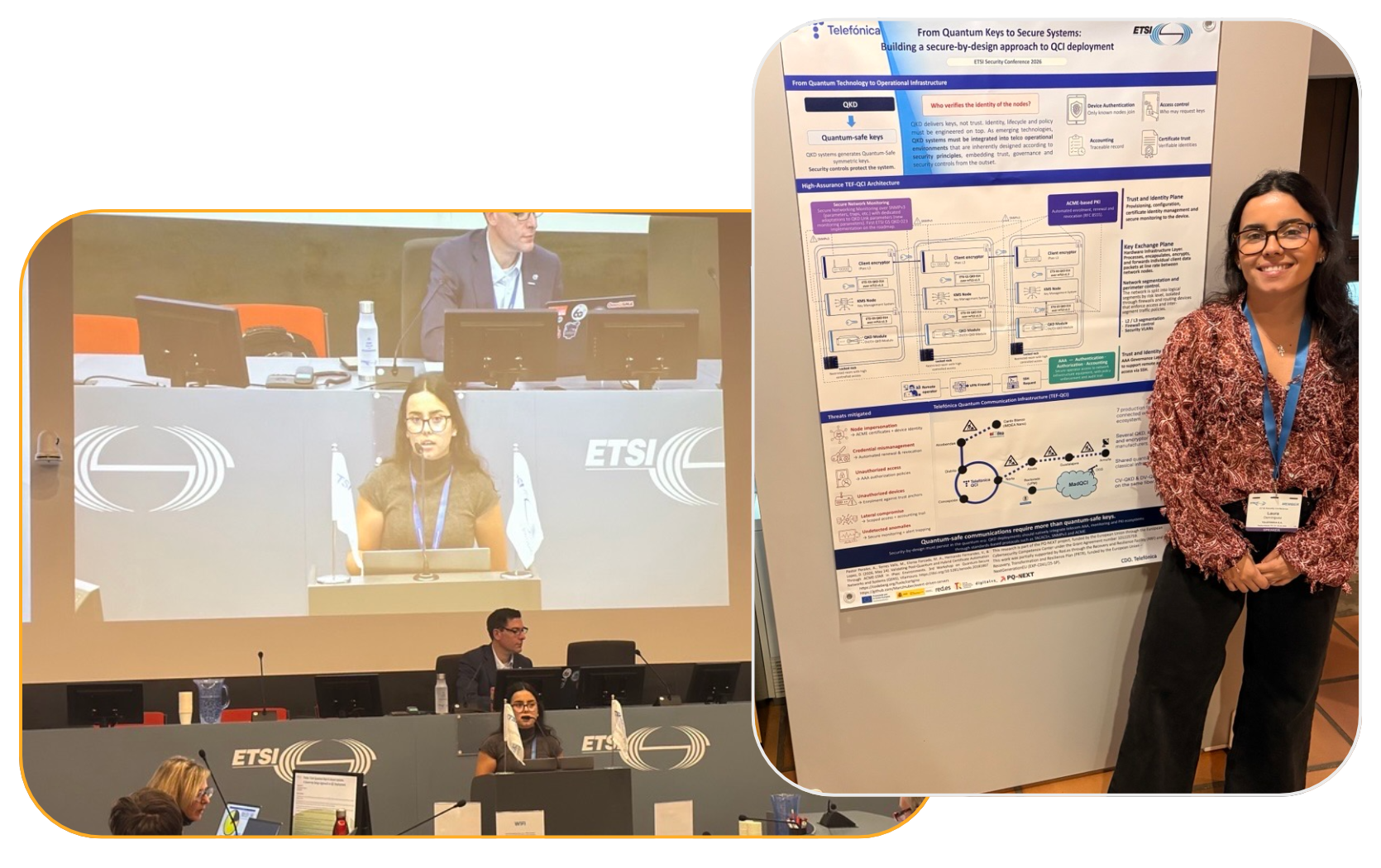
Following this, Diego R. Lopez from Telefónica travelled to Lisbon, Portugal, to attend the QIA Community Event 2026. In his presentation, “Why Quantum Networking Matters Now, Not Later”, he discussed the urgent need to prepare in advance for the quantum shift and presented the rationale behind PQ-NEXT’s activities. Telefonica also continued to participate in major events. This time, Laura Dominguez Cespedes, representing Telefonica, participated in the ETSI Security Conference 2026, presenting a poster on security issues and work on the PKI initiative based on the ACME protocol.
Laura’s Reflection:
“As expected, attending the ETSI Security Conference 2026 confirmed that the main cybersecurity trends and priorities across industry, vendors, regulators and standardisation bodies are currently focused on three major areas: AI Security, the Cyber Resilience Act (CRA), and the Quantum-Safe (QS) transition.For me, the most interesting part was the Quantum-Safe track, of course. Several presentations covered the work being carried out across standards bodies, protocol communities and technology vendors to enable the migration towards quantum-safe infrastructures. Discussions included PQC deployment, crypto-agility, PKI migration, hybrid approaches, IPsec/IKEv2 evolution and real-world transition experiences.
One of the key takeaways was seeing how all these initiatives are converging towards a common goal: enabling a practical migration path to quantum-safe technologies and the respecified need to adopt NIST PQC algorithms and migrate at least to TLS 1.3 right now.
The best part is that many of the topics discussed are aligned with the foundations we are already pursuing in PQ-NEXT: the migration of existing protocols towards quantum-safe alternatives, adoption of NIST post-quantum algorithm
s, crypto-agility, hybrid deployments, and the need to evolve PKI systems.”
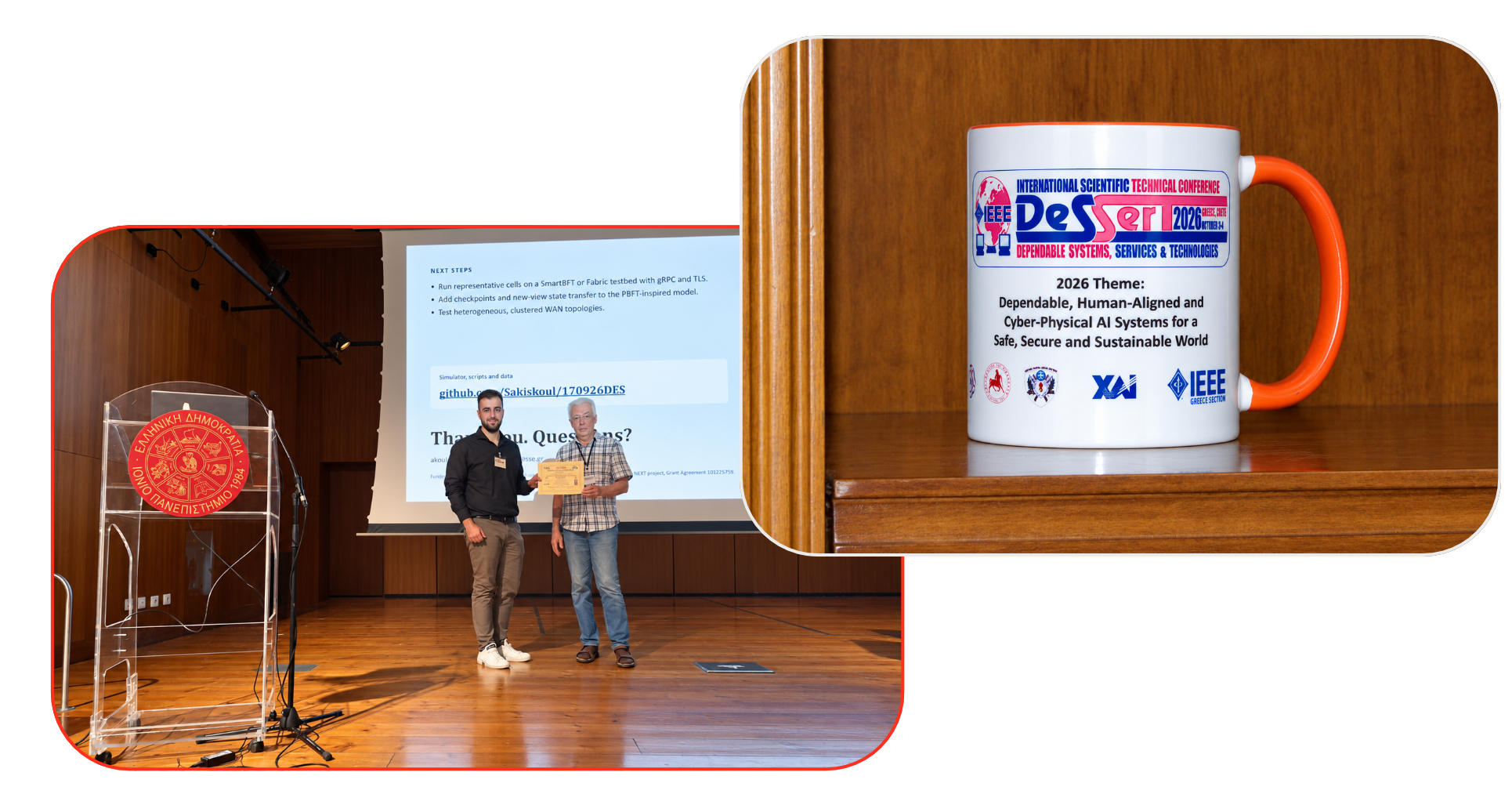
In September, our Infili partners delivered another insightful presentation. Sakis Koulianos participated in the 16th IEEE International Conference on Dependable Systems, Services and Technologies (DESSERT 2026), in Corfu, Greece, from October 2–4, 2026. The conference brought together researchers working on cybersecurity, dependable systems, and related technologies, with multiple interesting presentations and plenty of opportunities to meet people and exchange ideas. The presentation focused on how post-quantum digital signatures affect the performance of blockchain consensus protocols under different network conditions. One interesting question related to this work is how we can introduce stronger security without significantly affecting network performance, especially as blockchain networks become larger and more complex. His paper, “Topology-Aware Evaluation of Post-Quantum Signatures in Fabric-Inspired Ordering Networks”, will be available soon.
And last but not least, our project coordinator, Akis Kourtis, from Demokritos,
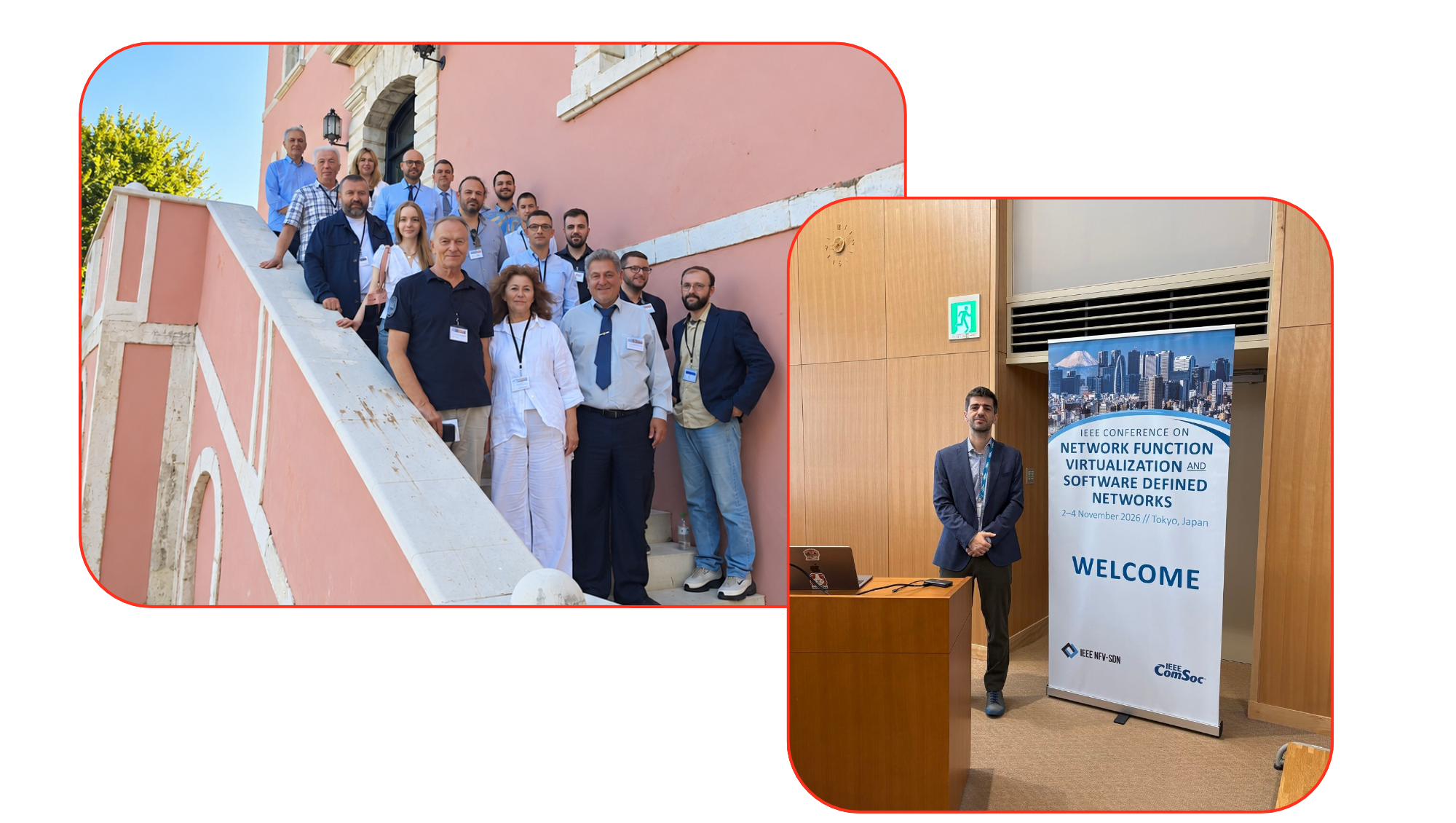 travelled to Tokyo, Japan, to attend the IEEE NFV-SDN 2026 conference. Two papers were presented. The first, “Adversarial Agentic AI for Dynamic Backdoor Evasion and Detection in Cloud-Native 5G Core Networks”, examines how persistent threats in cloud-native 5G cores can be detected, even when AI agents keep modifying them to evade conventional defences. Meanwhile, “Quantum-as-a-Service in the Softwarised Edge–Cloud Continuum” evaluates what it takes to run quantum workloads as cloud-native network functions, orchestrated across the edge–cloud continuum with the same tools operators already use.
And this is just the beginning. The PQ-NEXT project has completed its first year and is already delivering impact and early results.
Follow us on social media and stay tuned for upcoming events and the latest news!

PQ-NEXT Core: Meet Infili
What drives PQ-NEXT from within? PQ-NEXT Core reveals the minds and teams behind the project. By showcasing the perspectives, insights, and ambitions of those leading its key areas, we uncover the vision and collaboration that shape PQ-NEXT’s vision.
Let’s start by getting to know Infili as an organisation and the team that will work on the project.
Infili is a research-intensive SME based in Athens, Greece, with expertise in cybersecurity, secure software development, system integration, and EU-funded research and innovation projects. Founded in 2015, Infili has rapidly grown into a multidisciplinary team of highly skilled IT cybersecurity specialists and researchers with experience in developing and integrating secure digital solutions. In PQ-NEXT, Infili contributes to the development of Maintenance Tools, Network Security and Quantum-Resistant Communication, and the PQC Migration Toolbox, while supporting pilot integration and the quantum-safe digital identity and document services pilot in the Municipality of Aigaleo.
The Infili Team
Dr Antonios Litke is co-owner of INFILI Technologies, holding a Diploma in Computer Engineering and Informatics from the University of Patras and a PhD in Electrical and Computer Engineering from the National Technical University of Athens. He brings over 19 years of experience in ICT, having held senior positions such as R&D Manager, Technical Director, Project Manager, and Software Engineer in large-scale multinational projects. Within PQ-NEXT, he contributes to WP1, WP2, and WP4, providing technical oversight, supporting the development and integration of post-quantum security solutions, and guiding INFILI’s technical contributions to the project and pilot activities.
Nikolaos Papadakis is a Senior Scientific Advisor at INFILI and a Professor at the Hellenic Army Academy. With over 25 years of experience in industrial and research projects and involvement in more than 30 EU and nationally funded initiatives, he brings extensive scientific and technical expertise to the team. Within PQ-NEXT, he contributes to WP1, WP2, and WP4, providing scientific guidance, supporting technical planning, and advising on the development, integration, and validation of post-quantum technologies.
Ioannis Orthopoulos is a Project Manager at INFILI Technologies, holding a BEng in Telecommunications Engineering from the University of Essex and a BEng in Computer Science from the University of Portsmouth. Within PQNext, he focuses on WP4 activities, contributes to risk management, quality assurance, and the successful implementation of INFILI’s activities, particularly those related to the Municipality of Egaleo pilot.
Athanasios Koulianos is a Researcher and Software Engineer at INFILI Technologies, holding a BSc in Physics, an MSc in Cybersecurity, and currently pursuing a PhD in post-quantum blockchain security and privacy-preserving technologies. His research focuses on blockchain, post-quantum cryptography, zero-knowledge proofs, and distributed systems, with publications in Sensors (2024, DOI: 10.3390/s24175838) and PETRA (2024, DOI: 10.1145/3652037.3663889), as well as recent work on post-quantum blockchain performance presented at DESSERT 2026. Within PQ-NEXT, he contributes to the Aigaleo Municipality pilot, focusing on quantum-safe digital documents and secure municipal e-government services.
Chrysa Psyllaki is a Project Manager at INFILI Technologies, holding a BA in International and European Studies and an MA in International and European Policies on Education, Training and Research. She has extensive experience in the coordination and management of EU-funded research and innovation projects, overseeing project implementation, partner collaboration, reporting, and compliance with EU requirements. Within PQ-NEXT, she supports project coordination, administrative and financial management, monitors project progress and reporting requirements, and the effective collaboration of partners to ensure the timely achievement of project objectives.
What motivated you to join this EU-wide consortium?
Our motivation to join PQ-NEXT stems from our commitment to advancing cybersecurity and contributing to the development of secure, future-proof digital solutions. We see post-quantum cryptography as a critical step towards protecting digital infrastructures against emerging quantum threats. What makes it particularly interesting is that we are also addressing a real challenge faced by a Greek municipality, the Municipality of Aigaleo, where we will demonstrate quantum-safe digital identity and document services in a real-world setting. We also value the opportunity to work alongside partners from across Europe, share knowledge, and develop practical solutions that can make a real difference, particularly in digital identity and public services.
"We see post-quantum cryptography as a critical step towards protecting digital infrastructures against emerging quantum threats"
What problem does your role in the project address in simple terms, and why is it critical for the project’s implementation?
Within PQ-NEXT, INFILI focuses on supporting the transition to quantum-safe technologies, particularly in the areas of secure communications, cryptographic maintenance, and digital identity. In simple terms, we want to help organisations move from traditional security methods to solutions that can withstand future quantum threats, without disrupting their existing systems. A key part of our involvement is the pilot in the Municipality of Aigaleo, where we will help demonstrate how post-quantum cryptography can protect digital documents and identity verification in public services. This is important because it allows us to test these technologies in a real-world environment and show how they can improve the security and reliability of everyday services used by citizens.
"A key part of our involvement is the pilot in the Municipality of Aigaleo, where we will help demonstrate how post-quantum cryptography can protect digital documents and identity verification in public services"
What are the main activities, tasks, and objectives of your work?
At INFILI, we’re working on the PQ-NEXT pilot with the Municipality of Aigaleo. We built a digital workflow for the Property Exact Address Certificate, from online application and municipal approval to delivery in a digital wallet. Anyone who receives the certificate can verify it without contacting the municipality. We added post-quantum signatures to credentials and municipal records while keeping the credential format that existing wallets support. We also prepared the municipality’s decentralised identifier (did:ebsi), built the onboarding tools, and tested signing a credential with the municipality’s key through OpenBao. Our next steps are to complete EBSI registration and Trusted Issuer accreditation, connect our verifier to the EBSI DID Registry, and test the full workflow with mobile wallets and municipal staff.
How is your work connected to the other tasks and activities?
Our work at INFILI is connected to several activities across PQ-NEXT. We work closely with other technical partners on the maintenance tools, secure communication solutions, and the PQC Migration Toolbox, helping to make sure that everything works well together. An important part of our role is also putting these technologies into practice through the Municipality of Aigaleo pilot, where we will test quantum-safe solutions for digital identity and document services. This gives us the opportunity to see how the technologies perform in a real-world setting, identify any practical challenges, and share feedback with our partners to improve the overall project results.
What is the key outcome you personally hope this project will deliver?
As a team, we hope PQ-NEXT will deliver easy-to-adopt solutions that help organisations prepare for future quantum threats. We are particularly looking forward to demonstrating these technologies in the Municipality of Aigaleo and showing how they can improve the security of everyday public services. We would also love to see what we develop being used by other municipalities and organisations in Europe, making a real difference beyond the project itself.
"We are particularly looking forward to demonstrating these technologies in the Municipality of Aigaleo and showing how they can improve the security of everyday public services"
Looking ahead, what excites you most about the post-quantum era?
What excites us most is bringing post-quantum security into everyday services without making them harder to use. Someone should be able to receive a certificate on their phone and share it with another organisation without needing to know anything about the cryptography behind it. For us, the interesting challenge is making sure that the certificate can still be verified years later, even after the signing keys or algorithms have changed.